


Telus Mobile Plans Review: Best Options for Budget and Premium Users
Discover the best Telus mobile plans for 2026 in this detailed review covering affordable options for budget-conscious users and premium plans for heavy data users, families, and travelers. Compare pricing, features, coverage, and value to find the right Telus plan for your needs.
Table of Contents
- 1 Understanding TELUS in Canada's Mobile Market
- 2 Why TELUS Continues to Attract Canadian Customers
- 3 Overview of TELUS Mobile Plans in 2026
- 4 Best TELUS Plan for Budget Users
- 5 Best TELUS Plan for Average Smartphone Users
- 6 Why Millions of Canadians Choose TELUS
- 7 Best TELUS Plan for Premium Users
- 8 TELUS Network Coverage and Performance
- 9 TELUS vs Competitors
- 10 Pros and Cons of TELUS Mobile Plans
- 11 Tips to Save Money on a TELUS Mobile Plan
- 12 Who Should Buy a TELUS Mobile Plan?
- 13 Conclusion
- 14 Frequently Asked Questions
Understanding TELUS in Canada's Mobile Market
Canada has never been known as a cheap place for mobile service. For years, Canadians have compared prices with neighboring countries and wondered why wireless bills seem to climb higher every year. Despite this reputation, one provider consistently remains among the country’s top choices: TELUS. The company has built a reputation around reliability, nationwide coverage, premium customer service, and some of the fastest mobile data speeds available in Canada.
TELUS sits alongside Rogers and Bell as one of Canada’s “Big Three” carriers, serving millions of customers from British Columbia to Newfoundland. While smaller carriers continue to grow, many Canadians still prefer a premium provider because of better coverage in rural areas, stronger customer support options, and access to flagship smartphones with financing programs.
The challenge for consumers in 2026 is deciding whether TELUS’s premium pricing is actually worth paying for. Some users only need a few gigabytes of data every month and simply want affordable connectivity. Others stream 4K videos, travel internationally, use mobile hotspots daily, and require a plan that can keep up with their lifestyle. Fortunately, TELUS now offers options that appeal to both ends of the market.
Why TELUS Continues to Attract Canadian Customers
When customers choose a mobile provider, price is only one piece of the puzzle. Coverage matters just as much, especially in a country as geographically large as Canada. A cheaper plan means very little if calls constantly drop or mobile data disappears the moment you leave a major city.
TELUS has invested heavily in network infrastructure over the past decade, resulting in one of Canada’s strongest mobile networks. Independent reports continue to rank TELUS among the country’s leaders in download speed and network reliability. Coverage extends throughout urban centers, suburban neighborhoods, highways, and many rural communities that smaller carriers struggle to reach. Recent industry reports indicate that TELUS remains one of Canada’s best-performing networks for both LTE and 5G experiences.
Another reason customers stay with TELUS is ecosystem value. Mobile subscribers can combine services such as home internet, television, smart home solutions, and family mobile plans for additional savings. These bundles often reduce the overall cost enough to narrow the pricing gap between TELUS and budget competitors.
Overview of TELUS Mobile Plans in 2026
TELUS simplified much of its wireless lineup in 2026, focusing on three major categories: entry-level plans, unlimited standard plans, and premium 5G+ options. This structure makes selecting a plan considerably easier than in previous years when dozens of confusing promotional offers existed simultaneously.
Entry-Level 5G Plans
Entry-level plans target users who own their device and primarily use Wi-Fi at home or work. These plans generally provide moderate amounts of high-speed data with unlimited calling and texting throughout Canada. Industry pricing trackers show entry plans beginning around the fifty-dollar range with automatic payment discounts included.
Unlimited 5G Standard Plans
The standard unlimited category serves the majority of Canadians. These plans include generous high-speed data allowances followed by reduced speeds rather than expensive overage charges. For many families, students, and professionals, these plans hit the sweet spot between affordability and convenience.
Premium 5G+ Complete Plans
Premium subscribers gain access to TELUS’s fastest available speeds, international roaming benefits, enhanced hotspot usage, and larger device financing discounts. Certain premium plans also include international roaming in dozens of countries, reducing the stress of purchasing local SIM cards while traveling.
Best TELUS Plan for Budget Users
Budget-conscious consumers often assume TELUS automatically falls outside their price range. That assumption is no longer entirely accurate. While TELUS remains more expensive than discount brands, some of its bring-your-own-device offers provide surprisingly competitive value, especially when promotional discounts and family bundles are applied.
Who Should Choose Budget Plans
A budget TELUS customer usually fits a familiar profile. Perhaps you spend most of your day connected to home Wi-Fi or office internet. Maybe you primarily use your phone for messaging, navigation, social media, and occasional video streaming. If your monthly data consumption remains under twenty gigabytes, paying for a premium unlimited package simply does not make sense.
Students, retirees, and secondary line users often benefit most from these plans. Think of buying a pickup truck just to carry groceries once a week. You could do it, but you would spend a lot more money than necessary. Mobile plans work exactly the same way.
Pricing and Value Analysis
Current market data indicates that TELUS entry plans start around fifty dollars per month for customers bringing their own device and enabling automatic payments. The pricing becomes even more attractive when combined with family discounts or home service bundles. TELUS also offers discounts of up to fifteen dollars per line on eligible multi-line accounts.
Budget users should also evaluate whether a TELUS-owned alternative such as Koodo or Public Mobile better fits their needs. Both operate on the same network infrastructure while charging considerably less in many cases. The tradeoff usually comes in customer support availability, financing options, and premium features.
Best TELUS Plan for Average Smartphone Users
Most Canadians fall squarely in the middle of the market. They stream music during commutes, watch videos occasionally, use navigation apps daily, and participate in endless group chats that somehow never stop buzzing. For these customers, a moderate unlimited plan often provides the best experience.
Ideal Data Allowances
The average Canadian smartphone user consumes between twenty and fifty gigabytes of data each month. That amount supports social media browsing, video streaming, cloud backups, and video calls without creating anxiety about hitting limits halfway through the billing cycle.
TELUS unlimited plans eliminate overage surprises by slowing speeds after the high-speed allocation is exhausted rather than charging additional fees. Reduced speeds are still sufficient for messaging, email, and web browsing, although heavy video streaming becomes less enjoyable. TELUS currently caps post-threshold speeds at approximately 512 Kbps for many unlimited plans.
Family Discounts and Bundle Savings
Families often overlook one of TELUS’s biggest advantages: shared savings. Multi-line discounts can significantly reduce the effective monthly cost per user, especially when combined with home internet or television services.
Imagine four family members paying individually for separate plans. Now imagine combining them under one account and receiving monthly discounts on every line. Suddenly, TELUS becomes far more competitive against smaller carriers. This strategy explains why many families remain loyal to the company despite cheaper alternatives existing elsewhere.
Why Millions of Canadians Choose TELUS
Choosing a mobile carrier isn’t only about finding the cheapest monthly payment. Reliability matters just as much, especially for professionals, students, families, and remote workers who depend on uninterrupted connectivity every day. TELUS has built a strong reputation by offering consistent network performance across Canada while investing heavily in next-generation wireless infrastructure. Even in rural communities, customers frequently report dependable service compared to many regional competitors.
Another reason many Canadians remain loyal to TELUS is the extensive list of included features. Most plans include unlimited picture messaging, international texting, hotspot capability, spam protection through Call Control, and compatibility with smartwatches and tablets. Premium subscribers also gain access to generous roaming packages covering the United States and selected international destinations. These additions reduce the need for expensive add-ons and make the monthly subscription feel more valuable.

Best TELUS Plan for Premium Users
Premium customers have very different priorities. They want flagship smartphones, international travel support, maximum network speeds, and enough hotspot data to replace hotel Wi-Fi when necessary. For these users, premium plans often justify their higher cost.
International Roaming Benefits
Frequent travelers understand the pain of roaming bills. One careless week abroad can produce a mobile invoice large enough to ruin an otherwise perfect vacation. TELUS addresses this concern with international roaming options and select plans that include access in dozens of destinations worldwide.
The company’s newest premium offerings include roaming benefits across sixty-eight international destinations while maintaining access to a Canadian phone number and existing plan allowances. For business travelers and digital nomads, this convenience alone may justify upgrading to a premium package.
Device Financing Advantages
Premium subscribers also gain access to larger smartphone discounts and more favorable financing terms through programs such as Easy Payment and Bring-It-Back options. Rather than paying over two thousand dollars upfront for a flagship smartphone, customers can spread payments across multiple years.
This approach resembles leasing a vehicle rather than purchasing it outright. Some users appreciate lower monthly payments and frequent upgrades, while others prefer long-term ownership. Neither approach is inherently better; it simply depends on personal priorities and upgrade habits.
TELUS Network Coverage and Performance
A mobile plan becomes useless if the network cannot support it. Fortunately, network quality remains one of TELUS’s strongest selling points. Coverage extends across all provinces and territories, with especially strong performance throughout Western Canada and many rural regions.
TELUS’s 5G+ network now supports theoretical speeds approaching two gigabits per second in supported areas using compatible devices. Actual speeds vary depending on congestion, signal strength, and hardware capabilities, but real-world performance remains impressive by Canadian standards.
The company also introduced a five-year plan price lock on certain packages, adding predictability for customers concerned about inflation and regular carrier price increases. This feature has become increasingly valuable as Canadians continue looking for ways to stabilize monthly expenses.
Rent Cars Online: The Complete Guide to Affordable and Hassle-Free Car Rentals
How Cookly.me Helps Travelers Discover Authentic Cooking Classes
VCM_William Hill vs Competitors: Key Features and Differences Explained
PrivateVPN Review 2026: Features, Performance, and Security Explained
Top Benefits of Using BlackBull Markets Banking/Trading Services
TELUS vs Competitors
Choosing a carrier rarely happens in isolation. Consumers almost always compare multiple providers before signing a contract or porting a number.
Feature | TELUS | Rogers | Bell |
5G Coverage | Excellent | Excellent | Excellent |
Rural Coverage | Excellent | Very Good | Excellent |
Family Discounts | Yes | Yes | Yes |
Premium Roaming Options | Yes | Yes | Yes |
Device Financing | Yes | Yes | Yes |
TELUS vs Rogers
Rogers traditionally performs exceptionally well in Eastern Canada and major metropolitan areas. TELUS often receives stronger marks in Western provinces and certain rural regions. For most urban customers, the difference is unlikely to be noticeable during everyday use.
TELUS vs Bell
Bell and TELUS share significant portions of network infrastructure in many areas, meaning performance often appears nearly identical. Pricing and promotional offers usually become the deciding factors between the two providers.
TELUS vs Koodo and Public Mobile
This comparison is where things become interesting. Koodo and Public Mobile operate using TELUS infrastructure while targeting lower price segments. Public Mobile focuses heavily on value and self-service support, while Koodo positions itself as a middle ground between budget and premium experiences. Community discussions consistently highlight that coverage quality remains effectively identical because all three use the same underlying network.
Pros and Cons of TELUS Mobile Plans
Advantages
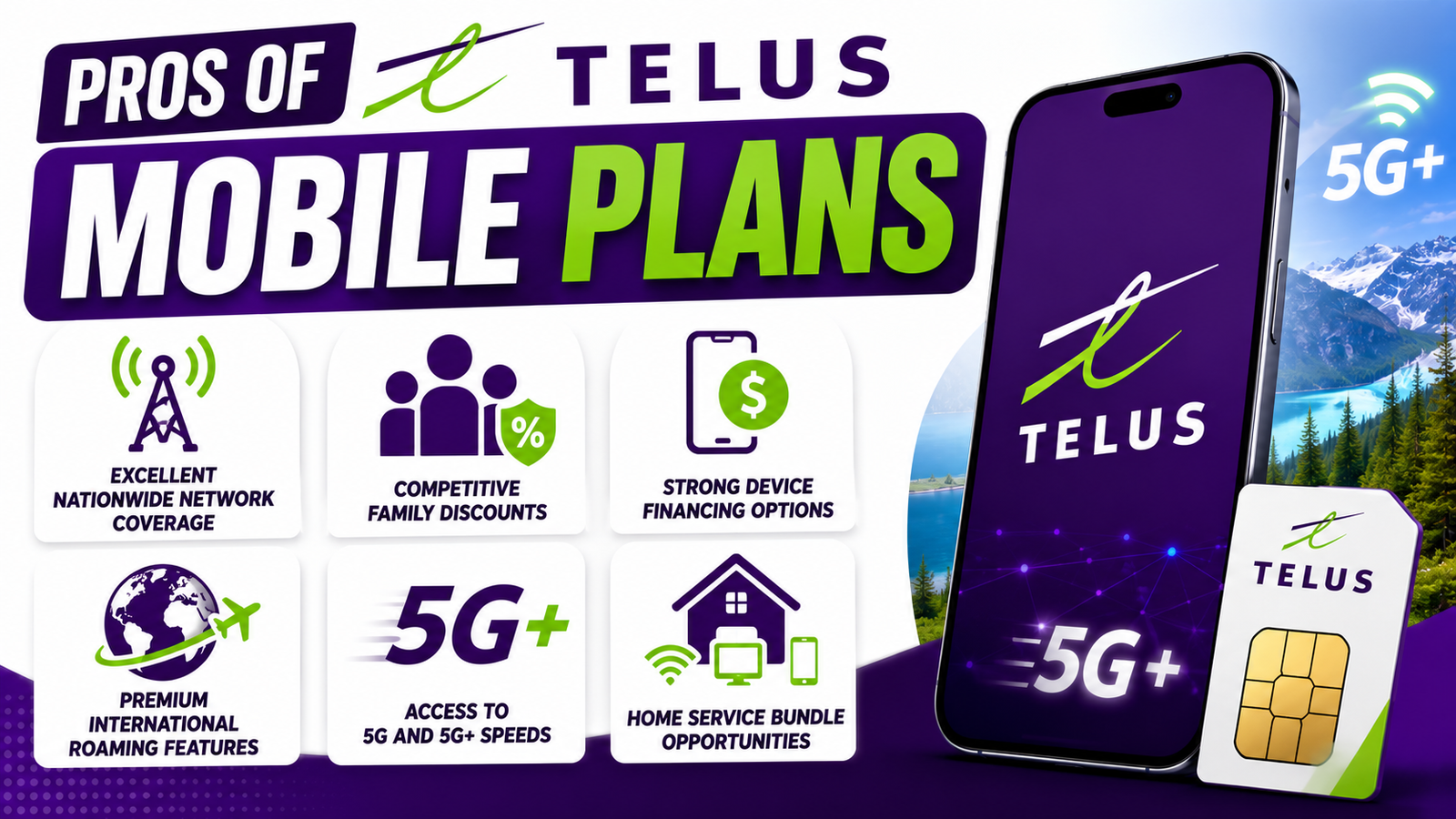
- Excellent nationwide network coverage.
- Competitive family discounts.
- Strong device financing options.
- Premium international roaming features.
- Access to 5G and 5G+ speeds.
- Home service bundle opportunities.
Disadvantages
- Pricing remains higher than discount competitors.
- Premium features may be unnecessary for light users.
- Some budget customers can save significantly with TELUS-owned alternatives.
- Device financing can increase total ownership costs over time.
Tips to Save Money on a TELUS Mobile Plan
Although TELUS is considered a premium wireless provider, there are several strategies that can help customers reduce their monthly costs without sacrificing essential features.
One of the easiest ways to save is by choosing a Bring Your Own Device (BYOD) plan. Since you are not financing a new smartphone through the carrier, your monthly payment is significantly lower. If your current phone still performs well, keeping it for another year or two can save hundreds of dollars.
Another effective strategy is enrolling in AutoPay whenever eligible. TELUS frequently provides monthly discounts for customers who enable automatic payments. While the savings may seem small each month, they add up over an entire year.
Who Should Buy a TELUS Mobile Plan?
Choosing the right mobile carrier depends on your lifestyle, monthly usage, travel habits, and budget. TELUS offers a wide range of plans, making it suitable for almost every type of user. If you value reliable network performance, excellent customer support, and access to Canada’s growing 5G+ infrastructure, TELUS deserves serious consideration. While its pricing is generally positioned in the premium segment, the added features and dependable service often justify the cost for many customers.
Students and light users who primarily browse social media, send messages, and stream occasional videos can save money with a Bring Your Own Device (BYOD) plan. These plans typically provide enough high-speed data for everyday activities while keeping monthly costs manageable. Users who already own an unlocked smartphone avoid device financing charges, making BYOD one of the most affordable ways to join the TELUS network.
Conclusion
TELUS continues to justify its reputation as one of Canada’s premier mobile providers in 2026. The company delivers outstanding coverage, reliable speeds, premium travel options, and attractive financing programs that appeal to customers seeking a high-end wireless experience.
Budget users should approach carefully. If your smartphone spends most of its life connected to Wi-Fi and you rarely exceed a modest data allowance, Koodo or Public Mobile may provide better value while using the same underlying network. On the other hand, families, professionals, international travelers, and technology enthusiasts may find TELUS worth every extra dollar.
Frequently Asked Questions
Q. Are TELUS mobile plans expensive?
TELUS generally costs more than discount carriers but remains competitively priced among Canada's premium providers.
Q. Does TELUS offer unlimited data?
Yes. TELUS offers multiple unlimited plans that reduce speeds after high-speed data allocations are reached rather than charging overage fees.
Q. Is TELUS 5G coverage available nationwide?
Coverage continues expanding rapidly and is available in most major Canadian cities and many surrounding communities.
Q. Can I finance a smartphone through TELUS?
Yes. TELUS offers Easy Payment financing and Bring-It-Back upgrade programs for eligible devices.
Q. Which TELUS plan offers the best value?
For most users, a mid-tier unlimited plan provides the best balance between price, speed, and flexibility.

Recent Post

Understanding Managed Hosting Features and Tools Offered by WP Engine

A Practical Guide to Making the Most of gymdolphin for Fitness

Discovering Contemporary Men’s Clothing Styles at Incerunmen

Why Online Shoppers Are Exploring UOOZEE for New Products

How Weblium.com Helps Simplify the Website Creation Process

Understanding Supplement Selection and Quality at BulkSupplements.com

How Digital Solutions Are Evolving With CHENGDU OUMEI NETWORK INFORMATION L.T.D

Beauty Trends Worth Exploring With Dominique Cosmetics – 122027

The Growing Role of 3D Scanning and Revopoint 3D Technologies Inc
Releted Post