


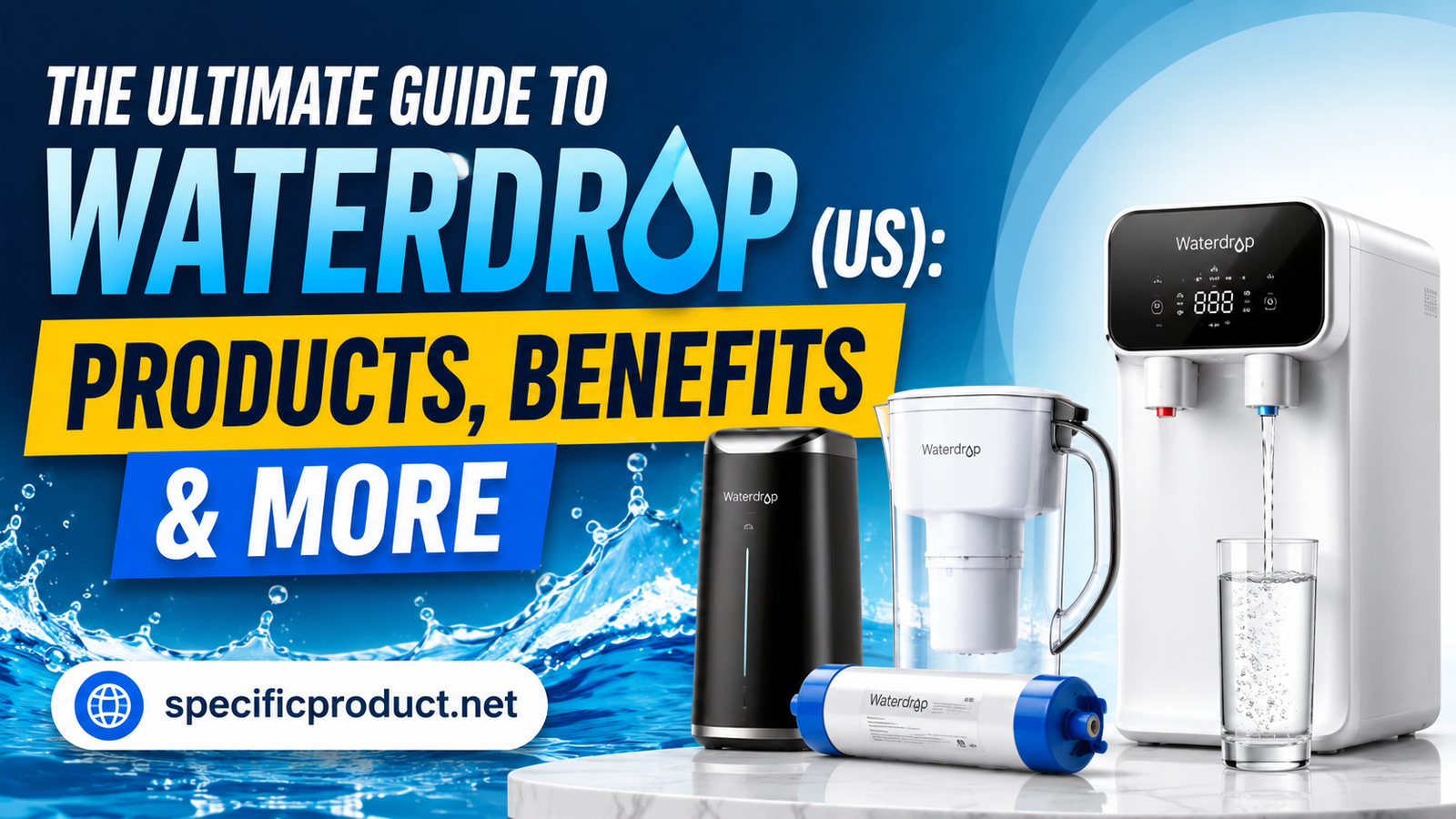
The Ultimate Guide to Waterdrop (US): Products, Benefits & More
Discover everything you need to know about Waterdrop (US), including its water filtration products, key benefits, filter types, reverse osmosis systems, pitchers, countertop filters, and more. This guide helps you understand the available options and choose the right Waterdrop (US) product for your home and drinking-water needs.
Table of Contents
- 1 What Is Waterdrop?
- 2 Waterdrop’s Approach to Water Filtration
- 3 Why Water Filtration Matters
- 4 Waterdrop Product Categories
- 5 Waterdrop Reverse Osmosis Systems
- 6 Benefits of Waterdrop Water Filters
- 7 Waterdrop Countertop Systems
- 8 Waterdrop Pitchers and Electric Filters
- 9 Choosing the Right Waterdrop System
- 10 Waterdrop Whole-House Filtration
- 11 Installation and Maintenance
- 12 Pros and Cons of Waterdrop
- 13 Waterdrop Filter Replacement Costs
- 14 Waterdrop vs. Traditional Bottled Water
- 15 Is Waterdrop Worth It?
- 16 Conclusion
- 17 Frequently Asked Questions
What Is Waterdrop?
Waterdrop is a water-filtration brand that sells products designed for different household needs, from simple pitchers to advanced reverse osmosis (RO) systems. Its US product range currently includes under-sink filters, countertop systems, RO dispensers, whole-house filtration, pitchers, electric dispensers, replacement filters, and related accessories. The brand’s official US catalog separates its products into several categories, making it possible to choose a system based on water usage, available space, and the level of filtration required.
The basic idea is simple: instead of relying only on bottled water or untreated tap water, you use a filtration system to improve the water coming into your home. The exact result depends heavily on the type of Waterdrop system you choose. A carbon-based pitcher is designed for a different job than an RO system, so it is important not to treat every Waterdrop product as if it provides the same level of purification.
Waterdrop’s Approach to Water Filtration
Waterdrop offers several filtration technologies rather than putting everything into one category. Some products use carbon filtration, while others use ultrafiltration or reverse osmosis. Certain models also add remineralization or alkaline features, while hot-and-cold dispensers focus on convenience as well as filtration.
That variety is one of the brand’s biggest advantages. A person living in a small apartment may want a compact countertop filter, while a family might prefer an under-sink or whole-house solution. Someone concerned about dissolved contaminants may specifically look at RO technology instead of a standard pitcher.
Why Water Filtration Matters
Tap water can contain substances that affect taste, odor, appearance, or overall water quality. The exact contaminants present depend on where you live and whether your water comes from a municipal supply or a private well. This is why checking your local water-quality report can be more useful than automatically buying the most expensive filter available.
A good filtration system should match the problem you are trying to solve. If your primary concern is chlorine taste, a suitable carbon filter may be enough. If you are specifically looking for reduction of dissolved solids or certain contaminants, an RO system may make more sense. The important point is that filtration performance is model-specific.
Common Water Quality Concerns
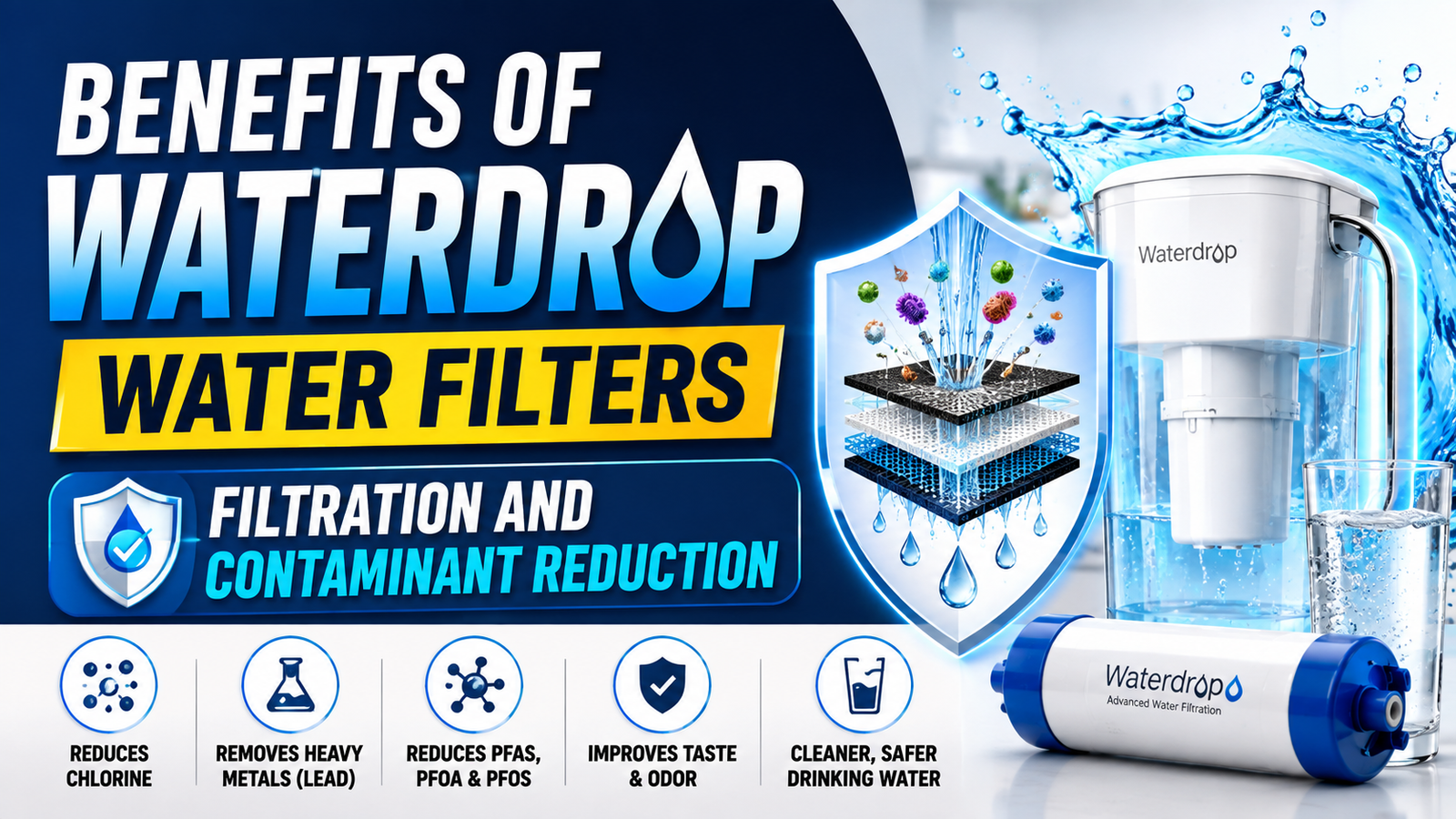
People commonly look for filtration because of concerns about chlorine, lead, sediment, unpleasant taste, odors, or other contaminants. Waterdrop’s product listings show that different systems make different claims and certifications. For example, some electric pitcher products are listed with NSF/ANSI 42, 53, 401 and 372 certifications, while certain RO products specifically advertise lead reduction.
That distinction matters when comparing products. A certification or contaminant claim should always be checked against the exact model rather than assuming that the entire Waterdrop range has identical capabilities.
Waterdrop Product Categories
Waterdrop’s US catalog is fairly broad, so understanding the major categories makes shopping much easier. The current product range includes under-sink filtration, countertop filtration, reverse osmosis, pitchers and dispensers, whole-house systems, and replacement filters.
Under-Sink Water Filters
Under-sink filters are designed to remain below the kitchen counter while supplying filtered water through a faucet or connected line. This is a practical option if you want filtered drinking and cooking water without keeping a large appliance on the countertop.
Waterdrop currently lists several under-sink technologies, including direct-connect carbon filtration, ultrafiltration, and RO systems. Some of its current under-sink RO models are marketed with capacities ranging from hundreds of gallons per day, depending on the model.
The main benefit is convenience. Once installed, you can use the filtered water whenever you open the faucet. The trade-off is that installation is generally more involved than using a pitcher, and replacement filters become part of your regular household maintenance.
Countertop Water Filters
Countertop systems are a popular middle ground. They provide more filtration capability than many basic pitchers while avoiding permanent under-sink installation. This makes them especially useful for renters, students, smaller kitchens, or anyone who does not want to modify existing plumbing.
Waterdrop’s current countertop selection includes conventional filtration, electric dispensers, and several RO systems. The company lists models such as the C1S, C1H, K19-H, M6H and M6SL, with different combinations of ambient, instant-hot, mineral, and remineralization features.
Reverse Osmosis Systems
Reverse osmosis is one of the most advanced filtration approaches in Waterdrop’s lineup. RO systems push water through a semipermeable membrane and can reduce a wide range of dissolved substances.
This makes RO attractive to consumers who want a deeper level of filtration than a standard carbon pitcher. However, RO systems can require more space, maintenance, and filter replacement than simpler systems. They can also produce wastewater depending on the design, so efficiency should be considered when comparing models.
Waterdrop Reverse Osmosis Systems
Waterdrop’s RO selection is one of the most extensive parts of its US catalog. Current models include countertop systems and under-sink systems, with options ranging from straightforward ambient-water machines to systems offering instant hot water or remineralization.
The C1S, for example, is positioned as a countertop CoreRO system, while the C1H adds instant-hot functionality. The K19-H is another countertop RO option designed around instant hot water. Higher-end models such as the M6 series add features such as mineral or remineralization options.
RO can be a good choice when your goal is extensive filtration, but it is not automatically the right choice for everyone. If you mainly want better-tasting municipal tap water, a simpler filter can be cheaper and easier to maintain.
Benefits of Waterdrop Water Filters
One of the biggest benefits of the Waterdrop range is choice. Instead of forcing every customer into one type of filtration system, the brand offers products for different budgets, kitchen layouts, and water-quality goals.
Another benefit is convenience. Some systems provide filtered water directly from a faucet, while countertop models can offer filtration without permanent installation. The newer countertop range also includes hot-and-cold options, meaning filtration and temperature control can be combined in one appliance. Waterdrop’s CT01, for example, is currently listed with adjustable temperatures from 59°F to 203°F.
Filtration and Contaminant Reduction
Filtration is where model selection becomes especially important. Waterdrop advertises different contaminant-reduction capabilities across its products, and some models carry NSF/ANSI certifications. Its ED01 electric countertop system, for example, is currently listed as certified to NSF/ANSI 401, 53, 42 and 372.
The practical lesson is simple: don’t buy based only on the Waterdrop name. Look at the exact product, certification, filter type, and contaminant claims. That approach gives you a much clearer idea of whether the product fits your water situation.
Waterdrop Countertop Systems
Countertop filtration is arguably one of Waterdrop’s most flexible categories. Current listings show products ranging from inexpensive electric filters to advanced RO dispensers. Prices vary significantly, with some basic electric systems around the $50 range and premium RO dispensers reaching several hundred dollars.
This category is particularly attractive for renters. You can get a filtration system without committing to plumbing work, and several products can sit directly on a kitchen counter. The downside is that countertop appliances occupy visible space, so you need to consider both the machine’s dimensions and the available room around it.
Waterdrop Pitchers and Electric Filters
Waterdrop’s pitchers are aimed at people who value affordability and simplicity. The company currently lists traditional pitchers such as the PT-04 and PT-07, while electric options include the ED01, ED02 and ED04.
The ED02 is listed as a 14-cup, 3.3-liter electric filter pitcher, while the ED04 is listed with a larger 27-cup, 6.3-liter capacity. Both are listed with NSF/ANSI 401, 53, 42 and 372 certifications on the current product catalog.
For a single person or couple, a pitcher may be all you need. Larger families may appreciate an electric dispenser or a direct-connect system because constantly refilling a small pitcher can become annoying.
Choosing the Right Waterdrop System
Choosing a Waterdrop product becomes much easier if you start with your needs instead of starting with the product catalog. Ask yourself how many people will use the water, how much counter space you have, whether you rent or own your home, and what contaminants or taste issues you are trying to address.
Need | Waterdrop option to consider | Main advantage |
Basic drinking-water filtration | Pitcher | Simple and affordable |
Filter without plumbing changes | Countertop system | Easy setup |
More extensive filtration | RO system | Strong filtration capability |
Filtered water from kitchen faucet | Under-sink system | Convenient daily use |
Hot and cold filtered water | Hot/cold dispenser | Convenience |
Whole-home treatment | Whole-house system | Wider household coverage |
The table is only a starting point because each product has different specifications. Always compare the exact model’s certification, filter life, capacity, installation requirements, and replacement-filter price before buying.
Exploring Convenient Shopping Options With Walmart Online Grocery
A Beginner’s Guide to Saving Money With Savvy Car Insurance Savings
Why Customers Are Exploring TransferGo for International Transfers
Explore Popular Tech Products and Accessories Available on Banggood
Make Smarter Buying Decisions With Drop: A Practical Shopping Guide
Waterdrop Whole-House Filtration
Whole-house filtration takes a different approach. Rather than filtering only the water used for drinking, these systems are designed to treat water entering the home. That can make sense when water quality concerns extend to showers, sinks, laundry, and other household uses.
However, whole-house filtration should be selected based on actual water conditions. A household dealing with sediment may need a different setup than one concerned about chlorine or other contaminants. Testing your water first can prevent you from spending money on filtration that does not address your specific problem.
Installation and Maintenance
One of the easiest mistakes is to think that buying a filter is the end of the process. It is actually the beginning. Every filtration system needs regular maintenance, and the filter eventually needs to be replaced.
Pitchers are generally the easiest to maintain because there is little installation involved. Countertop systems require more attention to filter changes and cleaning, while under-sink and whole-house systems may involve additional installation and plumbing considerations.
Keeping up with replacement schedules is important because a filter is not designed to work forever. The actual replacement interval varies by product and water usage, so users should follow the instructions for their particular Waterdrop model.
Pros and Cons of Waterdrop
Waterdrop has several strong points, but it is not perfect for every household.
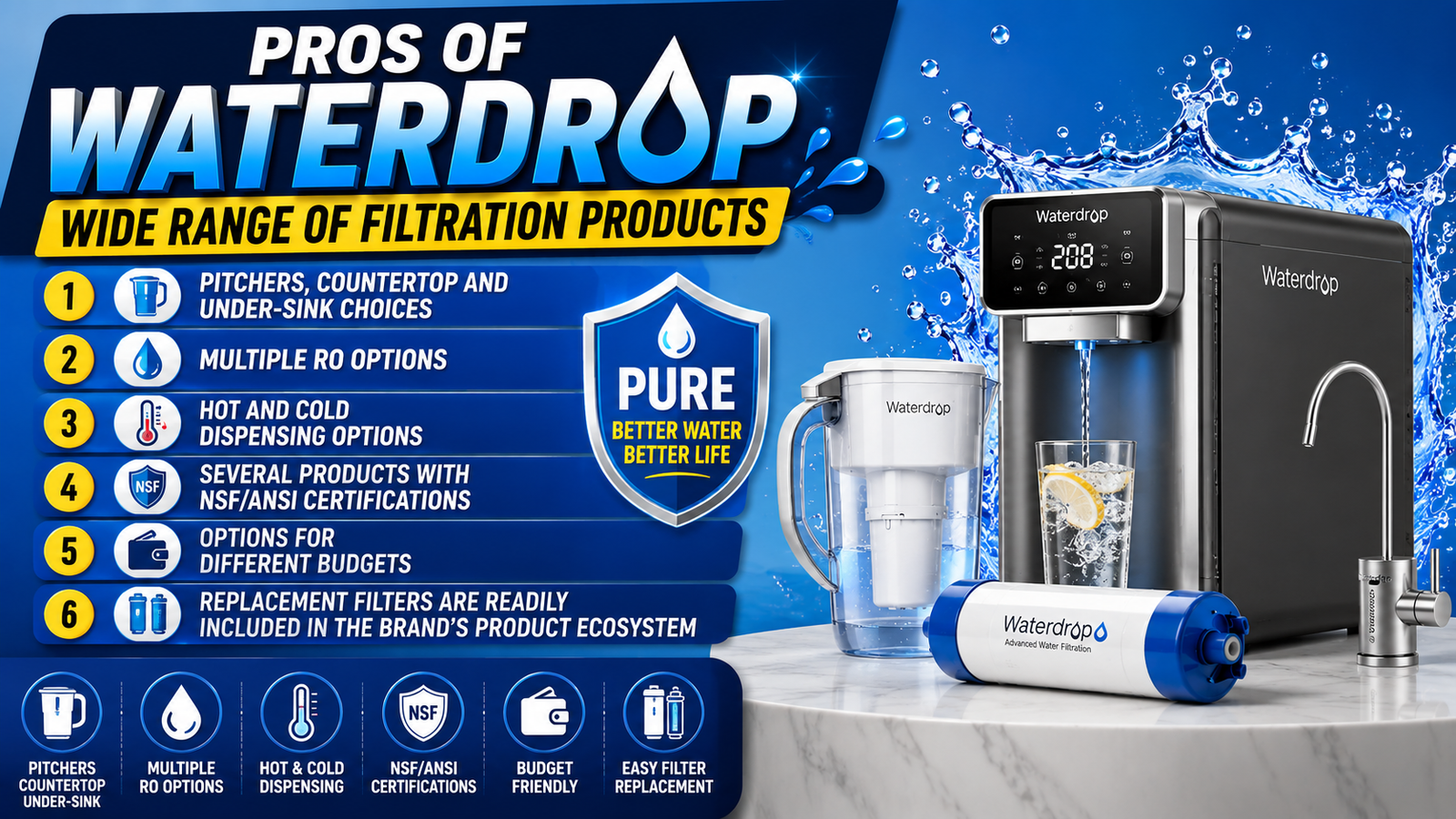
Pros:
- Wide range of filtration products
- Pitchers, countertop and under-sink choices
- Multiple RO options
- Hot and cold dispensing options
- Several products with NSF/ANSI certifications
- Options for different budgets
- Replacement filters are readily included in the brand’s product ecosystem
Cons:
- Product specifications vary significantly
- RO systems can cost substantially more than pitchers
- Replacement filters add ongoing costs
- Countertop systems take up kitchen space
- Some systems require more maintenance than others
- Installation can be more complicated for under-sink models
The biggest positive is variety, while the biggest challenge is choosing correctly. With so many models, it is easy to compare the wrong products or assume that one Waterdrop system performs like another.
Waterdrop Filter Replacement Costs
The initial price of a filtration system is only part of the total cost. Replacement filters can affect the long-term value considerably. Waterdrop’s current catalog lists replacement products separately, including filters for its K19 and A1 systems.
For example, the current US catalog lists the K19 replacement filter at $68.99, while individual A1 replacement filters are listed at $39.99 and $59.99, depending on the filter type. Prices can change, and promotions may affect what customers actually pay.
Before purchasing, calculate the expected yearly filter cost. A slightly cheaper machine can become more expensive over several years if its replacement filters are costly or need frequent replacement.
Waterdrop vs. Traditional Bottled Water
A home filtration system can also change how you think about drinking water. Instead of purchasing individual bottles repeatedly, you can filter water at home and use reusable containers.
The environmental and financial impact depends on how much bottled water you normally buy, the cost of your chosen filter, and how long the equipment lasts. A filtration system is not automatically cheaper in every situation, but frequent bottled-water users may find that the economics become attractive over time.
There is also the convenience factor. With a properly maintained home filter, filtered water is available whenever you need it rather than requiring another trip to the store.
Is Waterdrop Worth It?
For many households, Waterdrop can be worth considering, especially if you want multiple choices rather than a single type of filtration. The current US catalog covers everything from relatively inexpensive electric filters to advanced countertop and under-sink RO systems.
The better question is not simply, “Is Waterdrop good?” Instead, ask, “Is this specific Waterdrop model right for my water and my household?” That shift in thinking makes a huge difference.
If you want basic taste improvement, start with a suitable pitcher or carbon filter. If you want more extensive filtration, investigate RO. If you want convenience without installation, consider a countertop model. And if you want filtered water throughout the home, look into whole-house options.
Conclusion
Waterdrop offers a useful range of water-filtration solutions for US households, from simple pitchers to advanced reverse osmosis systems. Its current catalog shows a clear focus on giving customers different ways to improve drinking-water quality and convenience.
The best Waterdrop product depends on what you actually need. A renter may prefer a countertop system, a family may benefit from an under-sink filter, and someone looking for extensive filtration may prefer RO. The important thing is to compare the exact model rather than judging the entire brand from one product.
Ultimately, good water filtration is about matching the right technology to the right problem. Once you understand your water quality, household size, budget, installation limits, and maintenance requirements, choosing between Waterdrop’s many options becomes much simpler.
Frequently Asked Questions
Q. Is Waterdrop a good water-filter brand?
Waterdrop offers a broad range of filtration products, including pitchers, countertop filters, under-sink systems, and RO systems. Several products in its current US catalog carry NSF/ANSI certifications, although certification varies by model.
Q. Is Waterdrop reverse osmosis worth buying?
An RO system can be worthwhile if you want more extensive filtration than a basic pitcher or carbon filter provides. However, RO systems generally cost more and require regular filter maintenance.
Q. Does Waterdrop remove lead?
Some Waterdrop products specifically advertise lead reduction, but performance varies by model. The exact product specification and certification should be checked before purchasing.
Q. Are Waterdrop filters expensive?
The answer depends on the product. Basic filters can be relatively affordable, while replacement filters for larger RO systems can cost more. For example, current Waterdrop listings show individual replacement filters at different prices depending on the system.
Q. Which Waterdrop system should a beginner choose?
A beginner should generally start by identifying the water-quality issue, available space, and budget. A pitcher is the simplest option, while a countertop system provides more features without requiring permanent under-sink installation.
Recent Post
Understanding Managed Hosting Features and Tools Offered by WP Engine

A Practical Guide to Making the Most of gymdolphin for Fitness

Discovering Contemporary Men’s Clothing Styles at Incerunmen

Why Online Shoppers Are Exploring UOOZEE for New Products

How Weblium.com Helps Simplify the Website Creation Process

Understanding Supplement Selection and Quality at BulkSupplements.com

How Digital Solutions Are Evolving With CHENGDU OUMEI NETWORK INFORMATION L.T.D

Beauty Trends Worth Exploring With Dominique Cosmetics – 122027

The Growing Role of 3D Scanning and Revopoint 3D Technologies Inc
Releted Post