

A Complete Look at Uber Eats Global Delivery, Services, and Opportunities
Discover Uber Eats Global Delivery, including its worldwide reach, food and grocery delivery services, merchant solutions, courier opportunities, technology, pricing, and future growth. Explore how Uber Eats connects customers, businesses, and delivery partners while shaping the future of global local commerce.
Table of Contents
- 1 What Is Uber Eats?
- 2 How the Uber Eats Marketplace Works
- 3 Uber Eats Global Reach and Current Scale
- 4 Core Uber Eats Delivery Services
- 5 How Uber Eats Serves Merchants
- 6 Key Features of Uber Eats Global Delivery
- 7 Uber Direct and Local Business Delivery
- 8 The Role of Uber One
- 9 Benefits for Customers
- 10 Opportunities for Delivery Drivers and Couriers
- 11 Global Expansion and Market Opportunities
- 12 Benefits for Restaurants and Retailers
- 13 Technology Behind Uber Eats
- 14 Challenges Facing Uber Eats
- 15 The Future of Global Delivery
- 16 Conclusion
- 17 Frequently Asked Questions
What Is Uber Eats?
Uber Eats is Uber’s global delivery marketplace that connects customers with restaurants, grocery stores, convenience businesses, retailers, and delivery couriers through a single digital platform. Instead of calling a restaurant, searching for a nearby store, or arranging a separate courier, customers can open the Uber Eats app, choose what they need, pay digitally, and follow the order through delivery. The service has grown well beyond its original restaurant-delivery identity. Uber says the platform now works with more than 1.5 million merchants across 11,000+ cities and six continents, showing how delivery has become an important part of the wider Uber ecosystem.
The basic idea is simple, but the marketplace behind it is surprisingly sophisticated. A customer places an order, the merchant prepares it, and Uber’s courier network helps move the order from the merchant to the customer. The platform handles important pieces of the experience, including digital ordering, payments, dispatching, tracking, promotions, customer communication, and merchant tools. This creates a three-sided marketplace involving customers, merchants, and couriers, with Uber providing the technology that helps coordinate all three. That model is one of the main reasons Uber Eats can operate at a large international scale while still serving neighborhood restaurants and smaller retailers.
How the Uber Eats Marketplace Works
Think of Uber Eats as a digital bridge between local supply and local demand. Customers want convenience, restaurants want additional orders, retailers want more ways to reach shoppers, and couriers want flexible earning opportunities. Uber’s platform brings these needs together and uses location, availability, order information, and delivery capacity to coordinate the process. The customer sees a storefront, the merchant receives the order, and the courier receives delivery information when applicable.
This model also gives Uber an important advantage: people who already use Uber for transportation can discover delivery services without having to build a completely separate relationship with another company. Uber reported that nearly one-third of new Uber Eats customers came through the Uber app in the first quarter of 2025. Its membership program also represented about 60% of Delivery Gross Bookings at that time, demonstrating how Uber is using its broader ecosystem to encourage repeat delivery activity.
Uber Eats Global Reach and Current Scale
Uber Eats has become a genuinely international delivery platform rather than a service concentrated in only a few major markets. Uber’s current help information says Uber Eats is available in more than 6,000 cities across 45 countries, while Uber’s broader merchant materials describe more than 11,000 municipalities where its merchant ecosystem operates. The difference reflects how different Uber sources define geographic coverage, so these numbers should not be treated as identical measures. Either way, the scale is substantial and demonstrates the platform’s international reach.
The business has also moved into areas beyond traditional restaurant delivery. Grocery, convenience, retail, and local package delivery have become increasingly important parts of Uber’s strategy. In its second-quarter 2026 prepared remarks, Uber said Delivery Gross Bookings grew 25% year over year, while Grocery & Retail grew faster than restaurant delivery. Uber also highlighted Australia, the United Kingdom, and Mexico among leading international growth markets.
Countries, Cities, Customers, and Merchants
The numbers illustrate why Uber Eats is important in the global delivery industry. Uber reported that 140 million customers had something delivered with Uber Eats in 2024, while its platform supported more than 1.5 million merchant partners. These merchants include restaurants as well as grocery, convenience, and retail businesses.
Metric | Current reported figure |
Merchant partners | 1.5 million+ |
Municipalities | 11,000+ |
Continents | 6 |
Customers receiving delivery in 2024 | 140 million |
Uber Eats availability | 6,000+ cities / 45 countries |
2026 Q2 Delivery Gross Bookings growth | 25% YoY |
These figures show that Uber Eats is no longer simply a food-ordering app. It is becoming a broader local commerce infrastructure, helping consumers purchase physical products while giving businesses access to delivery capabilities they might otherwise have to build themselves.
Core Uber Eats Delivery Services
Restaurant delivery remains one of the most recognizable Uber Eats services. Customers can browse restaurants, compare menus, select meals, customize orders, pay through the platform, and monitor delivery progress. The experience is designed around convenience, but the underlying system has to coordinate thousands of independent restaurants and couriers while dealing with changing demand throughout the day. Lunch periods, dinner rushes, weekends, weather, events, and holidays can all change order volumes dramatically.
Restaurant Food Delivery
For restaurants, Uber Eats can act as an additional sales channel. A small restaurant does not necessarily need to build its own ordering application, maintain a large delivery fleet, or create a sophisticated digital marketing system from scratch. Instead, it can use Uber’s marketplace to appear in front of nearby customers and potentially receive orders from people who have never visited the restaurant physically.
Grocery and Retail Delivery
Grocery and retail delivery represent one of the biggest opportunities for Uber Eats because customers do not only need restaurant meals. They also need groceries, convenience products, household items, flowers, pharmacy-related goods where permitted, and other everyday products. By supporting these categories, Uber can potentially increase how often customers use its platform.
The expansion is already visible in Uber’s financial commentary. During Q2 2026, Uber said Grocery & Retail significantly outgrew restaurants within Delivery. That is an important signal because it suggests the long-term opportunity may be much larger than restaurant ordering alone.
How Uber Eats Serves Merchants
One of the strongest parts of the Uber Eats model is that the platform is designed not only for consumers but also for businesses. Restaurants and retailers can use merchant tools to manage menus or inventory, receive orders, communicate with customers, monitor performance, and participate in marketing programs. Uber’s merchant onboarding requirements include operating in an available geography, being a licensed business selling eligible prepared food or essential/convenience products, and providing menu or inventory information.
For a growing business, the value can extend beyond simply receiving delivery orders. Digital exposure can introduce a local restaurant to customers outside its traditional walk-in area. Marketing features can help merchants promote products, while integration with restaurant-management platforms can reduce repetitive work. Uber and Toast, for example, announced expanded integrations designed to connect restaurant operations, Uber Eats, Uber Direct, offers, and advertising tools.
Merchant Technology and Marketing Tools
Modern delivery platforms are increasingly becoming technology partners for merchants. Uber has been adding tools designed around operational efficiency, marketing, customer engagement, and business insights. Its 2026 merchant announcement highlighted AI, real-time communication, and community-generated content as areas of development.
That matters because merchants do not only need delivery drivers. They need help understanding demand, reaching customers, promoting products, and managing orders efficiently. The more useful the technology becomes, the more difficult it may be for a merchant to view Uber Eats simply as another ordering website. It can become part of the merchant’s daily operating system.
Key Features of Uber Eats Global Delivery
Global Delivery Network
Connects customers with restaurants, grocery stores, and retailers across many countries and cities.
Restaurant Food Delivery
Lets users browse menus, place food orders, make payments, and track deliveries.
Grocery & Retail Delivery
Provides convenient access to groceries, convenience products, household items, and other local goods.
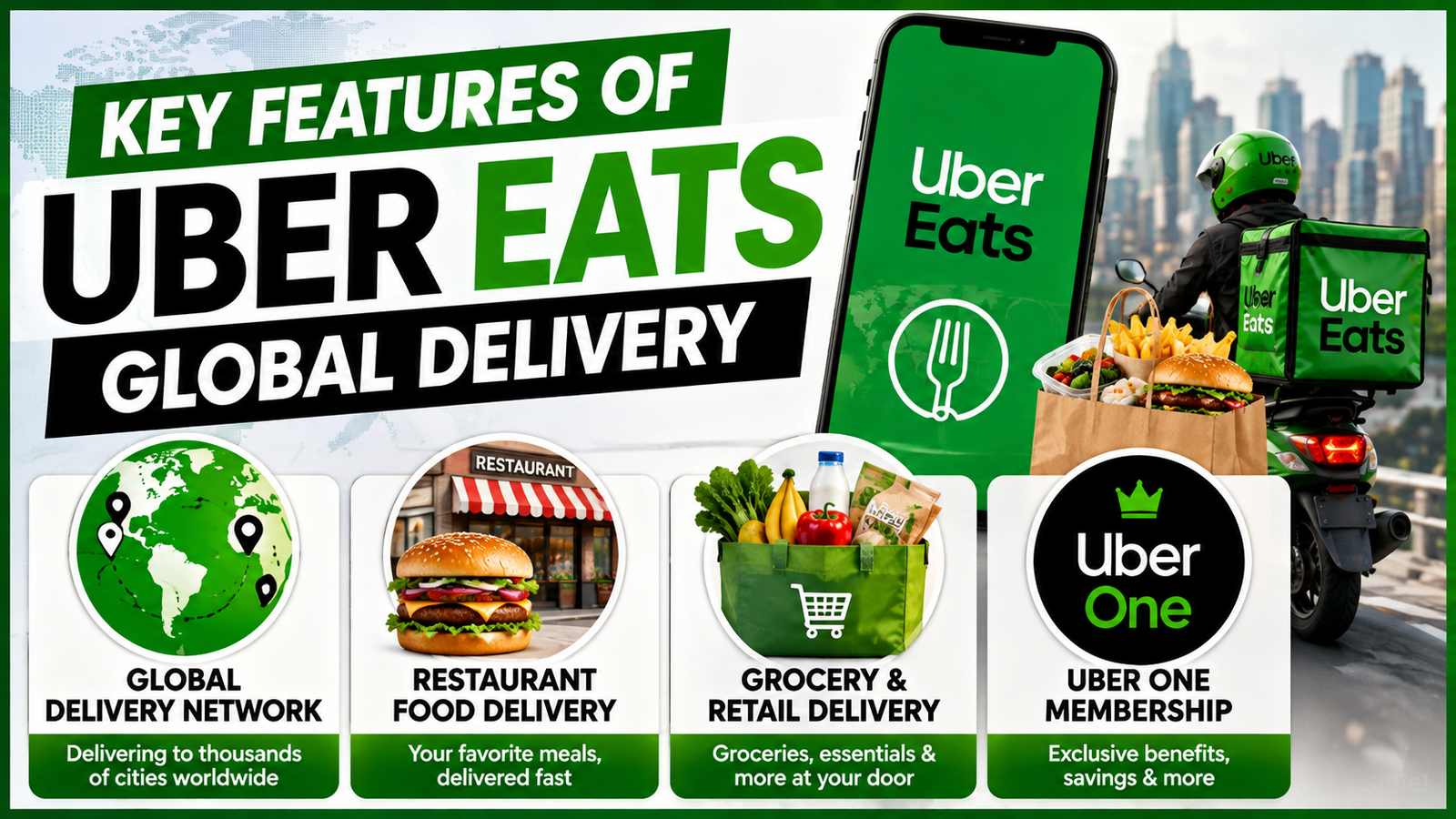
Uber One Membership
Offers eligible members delivery-related benefits and encourages frequent use of Uber and Uber Eats.
Uber Direct and Local Business Delivery
Uber Direct takes the delivery concept one step further. Instead of requiring a customer to order through Uber Eats, businesses can use Uber’s courier network to deliver orders generated through their own websites, apps, or other channels. Uber describes the service as a way for restaurants, retailers, and other businesses to handle high order volumes or supplement their existing delivery fleets.
This creates an interesting opportunity for businesses that want to maintain their own customer relationship while outsourcing the difficult logistics of last-mile delivery. A retailer can potentially accept an order through its own website and then use Uber’s courier network to complete the delivery. In other words, Uber is not only competing for the customer’s ordering screen; it can also become the infrastructure operating behind the scenes.
The Role of Uber One
Membership is another important piece of Uber’s delivery strategy. Uber One is designed to encourage customers to use Uber’s services more frequently by combining benefits across eligible Uber and Uber Eats transactions. The strategic logic is straightforward: if customers already pay for a membership, they have an additional reason to use the platform repeatedly instead of switching between competing services.
Uber’s 2025 prepared remarks showed the importance of this strategy, with membership accounting for around 60% of Delivery Gross Bookings at the time. Membership can potentially improve customer retention while increasing engagement across Uber’s different services.
Benefits for Customers
For consumers, the biggest advantage is convenience. Instead of traveling to a restaurant, waiting in a queue, or making a separate trip to a store, customers can order from their phone and receive products at their location. Real-time order information can also make the process easier because customers can see updates rather than wondering whether an order has been accepted, prepared, or picked up.
Choice is another major benefit. A single platform can expose customers to restaurants and stores they may not have discovered otherwise. Promotions, delivery options, pickup choices, and membership benefits can make the experience more flexible. Of course, convenience does not automatically mean the lowest possible price, so customers still need to consider delivery charges, service fees, menu pricing, tips, and promotional terms when comparing options.
Key Features and Services Investors Should Know About Hargreaves Lansdown
Key Features to Consider When Reviewing Pets Best Pet Insurance
A Complete Guide to Building Better Websites With MH Themes
Elevate Your Photography Setup With Manfrotto: A Complete Guide
Smart Shopping in Australia: How to Find the Best Deals on Kogan Australia
Opportunities for Delivery Drivers and Couriers
Couriers are the physical connection between the digital marketplace and the customer’s front door. Without them, even the best-designed ordering application would remain a screen. Uber’s model gives eligible drivers and delivery couriers an opportunity to use the platform for delivery work, often alongside other Uber services.
The opportunity can be attractive because demand changes throughout the day. Dinner periods, weekends, holidays, bad weather, major events, and busy commercial areas can all influence delivery activity. At the same time, courier earnings are affected by local demand, expenses, incentives, distance, wait time, vehicle costs, and applicable local regulations. Therefore, the opportunity should be viewed as flexible work rather than guaranteed income.
Global Expansion and Market Opportunities
Uber Eats still has significant room to expand because delivery habits differ dramatically between countries. Some markets have strong restaurant-delivery cultures, while others are seeing rapid adoption of grocery and retail delivery. Suburban communities, smaller cities, and less densely populated areas can create new opportunities if delivery economics can be made efficient enough.
Uber’s recent performance suggests that international expansion remains important. During Q2 2026, the company said its category position improved across all ten of its largest international markets, while Australia, the UK, and Mexico led growth.
Uber’s proposed acquisition of Delivery Hero also demonstrates the strategic importance of international delivery. In July 2026, Uber announced an offer valuing Delivery Hero’s equity at approximately $14.8 billion, with the transaction structured around acquiring businesses in 50 markets generating $42 billion in 2025 Gross Bookings, while other businesses in 14 markets would go to SSW Partners. The transaction remains subject to conditions, so these proposed market changes should not be treated as completed expansion.
Benefits for Restaurants and Retailers
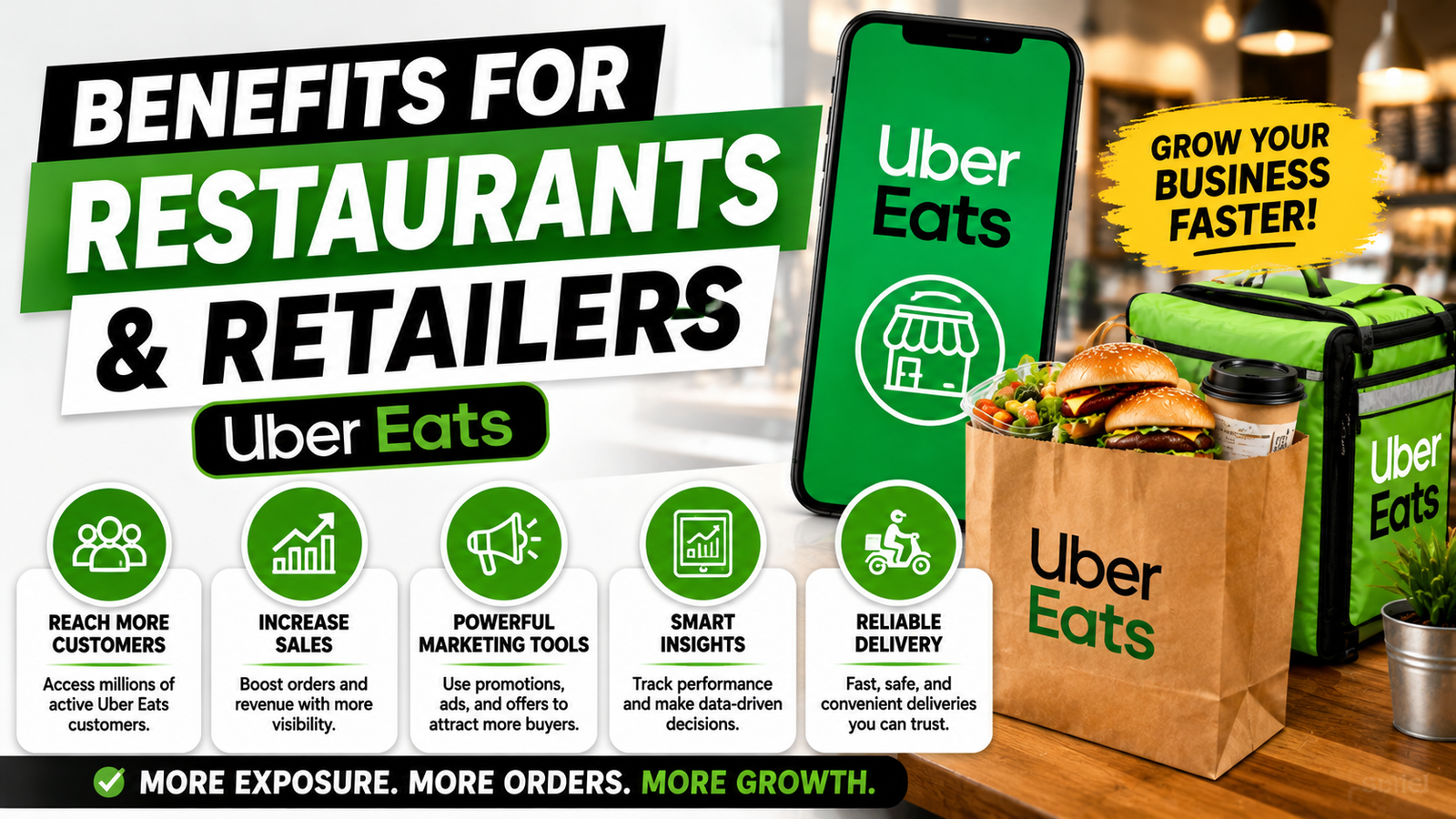
For merchants, Uber Eats can provide customer acquisition, delivery infrastructure, digital visibility, and operational tools. A neighborhood restaurant that has limited marketing resources can potentially reach thousands of nearby app users. A retailer can add local delivery without maintaining a large dedicated courier fleet. A growing business can also use data and platform tools to understand customer behavior and improve its digital presence.
Uber’s merchant impact data provides some indication of the broader economic role. Its 2025 report said Uber Eats had more than 1.5 million merchants globally and estimated that its U.S. activity supported 47,000 additional jobs for merchant partners. The report also estimated that U.S. couriers earned $1.3 billion through Uber Eats in 2024.
Technology Behind Uber Eats
Technology is the engine that makes a global delivery marketplace possible. Every order creates a chain of decisions: which merchant should receive it, when the food should be prepared, which courier should collect it, how the route should be handled, and how the customer should receive updates. Multiply that process across thousands of cities and millions of transactions, and the operational challenge becomes enormous.
Uber’s technology also has to adapt to local conditions. Traffic patterns differ from city to city, restaurants operate differently, customer expectations vary, and regulations can change by country. Machine learning, mapping, automated dispatch, demand forecasting, digital payments, customer reviews, and merchant analytics all contribute to the platform’s ability to coordinate this complicated marketplace.
Challenges Facing Uber Eats
The global delivery industry is highly competitive. Uber Eats competes with local and international platforms, restaurant-owned ordering systems, grocery delivery services, and traditional pickup. Customers can easily compare prices and delivery times, which puts pressure on platforms to maintain reliable service without making the final price unattractive.
Merchant economics are another major challenge. Restaurants need enough revenue from delivery orders to justify marketplace and delivery costs. Uber has changed its U.S. restaurant marketplace fee structure over time; its current U.S. information lists delivery packages of 20%, 25%, and 30%, depending on the package and circumstances, while pickup pricing can be lower. Uber also says fee structures can vary by market, so U.S. rates should not be assumed to apply globally.
The Future of Global Delivery
The next stage of Uber Eats is likely to be broader than food. Grocery, retail, convenience, local packages, business deliveries, and direct-to-consumer logistics can all fit within the same basic infrastructure. The company already says Grocery & Retail is growing faster than restaurant delivery, while Uber Direct extends its courier network to businesses that want delivery without necessarily relying on the Uber Eats marketplace.
Partnerships may also become increasingly important. Uber’s expanded relationship with Block and its work with Toast show how delivery platforms can connect with point-of-sale systems, payment services, restaurant software, and business operations. These integrations could make delivery less like a separate service and more like an invisible layer built into everyday commerce.
Conclusion
Uber Eats has evolved from a restaurant-delivery application into a global local-commerce platform. Its network now connects customers with restaurants, grocery stores, retailers, and other businesses while giving merchants access to technology and courier infrastructure. With more than 1.5 million merchant partners, 140 million customers receiving deliveries in 2024, and continued growth in Grocery & Retail, the scale of the opportunity is considerable.
The most interesting part of Uber Eats’ future may not be another restaurant order. It could be the grocery basket, retail package, pharmacy-eligible product, business shipment, or local delivery completed through Uber Direct. As digital ordering becomes more normal and customers expect faster local fulfillment, Uber’s ability to combine its marketplace, courier network, technology, and membership ecosystem could make delivery an increasingly important part of everyday commerce.
Frequently Asked Questions
Q. What is Uber Eats mainly used for?
Uber Eats is primarily used to order food from restaurants, but the platform has expanded into grocery, convenience, retail, and other local delivery categories. Availability depends on the market.
Q. How many merchants use Uber Eats?
Uber currently reports more than 1.5 million merchant partners across more than 11,000 cities or municipalities and six continents.
Q. Is Uber Eats available worldwide?
No. Uber Eats operates across many international markets but is not available everywhere. Uber's current help page says it is available in more than 6,000 cities across 45 countries.
Q. What is Uber Direct?
Uber Direct is a delivery service that allows businesses to use Uber's courier network for local deliveries, including orders that originate through the business's own website or other channels.
Q. What is the biggest opportunity for Uber Eats?
A major opportunity is expanding beyond restaurant delivery into grocery, retail, convenience, and local commerce. Uber's 2026 results indicate that Grocery & Retail is already growing faster than restaurant delivery.

Recent Post

Understanding Managed Hosting Features and Tools Offered by WP Engine

A Practical Guide to Making the Most of gymdolphin for Fitness

Discovering Contemporary Men’s Clothing Styles at Incerunmen

Why Online Shoppers Are Exploring UOOZEE for New Products

How Weblium.com Helps Simplify the Website Creation Process

Understanding Supplement Selection and Quality at BulkSupplements.com

How Digital Solutions Are Evolving With CHENGDU OUMEI NETWORK INFORMATION L.T.D

Beauty Trends Worth Exploring With Dominique Cosmetics – 122027

The Growing Role of 3D Scanning and Revopoint 3D Technologies Inc
Releted Post