


Society6 Review: Features, Earnings, and Product Quality Breakdown
Have you ever considered whether the Artist & Buyer Review on Society6 Marketplace Is the website still a thriving print-on-demand platform or has it devolved into a substandard marketplace? that leaves artists and buyers frustrated? In this deep dive, we’ll explore everything you need to know in 2026 — from how it works to earnings potential, product quality, customer experiences, competitor comparison, and whether it’s worth your time. By the end of this article, you’ll have a thorough understanding of Society6 — both the good and the gritty.
Table of Contents
- 1 What Is Society6?
- 2 How Society6 Works
- 3 Artist Earnings and Royalties
- 4 Product Quality Review
- 5 Key Features of Society6
- 6 Pricing, Fees, and Value for Money
- 7 Customer Service and Support
- 8 Artist Experience – The Good, Bad, and Reality
- 9 Advantages of Selling on Society6
- 10 Disadvantages of Selling on Society6
- 11 Alternatives and Competitors
- 12 Who Should Use Society6 in 2026
- 13 Conclusion
- 14 Frequently Asked Questions
What Is Society6?
History and Background
Society6 first launched in 2009 as a print‑on‑demand platform designed to connect independent artists with a global audience. Instead of selling artwork in traditional formats, artists can upload digital designs that are printed onto products like wall art, home decor, apparel, accessories, and lifestyle items.
The company handles manufacturing, order processing, customer support, and shipping — giving artists a hands‑off way to earn money without managing inventory or fulfillment. It’s part of Leaf Group, which is owned by the NYSE‑listed Graham Holdings Company, adding legitimacy and credibility to its operations.
How Society6 Works
Society6 functions as a curated marketplace. Artists upload artwork and the platform places that artwork onto various product templates automatically. Buyers browse, select products, and place orders — Society6 then produces and ships the products directly. This model eliminates operational hassle for artists, leaving them free to focus on creativity.
This appeals to a lot of artists since it eliminates the need to spend money on logistics or tangible goods. Instead, you upload once and hope your designs attract buyers. However, that simplicity hides a deeper reality: economics, visibility, and quality can all be less than ideal. Let’s explore further.
Artist Earnings and Royalties
Commission Structure Explained
Society6’s artist earnings model is unique among print‑on‑demand platforms — but not always favorable. Most products have a fixed royalty, usually around 10% of the net sale price. Only certain art prints allow artists to set a markup, making them potentially more profitable than other items.
This limited pricing control contrasts sharply with platforms like Redbubble, where artists can set margins on nearly all products.
Real Earnings Artists Can Expect
Because earnings are a small percentage of the retail price, individual profits per item tend to be modest. For example:
- A $40 throw pillow might earn an artist around $4
- A framed art piece at $80 might yield about $8
- A $16 mug might only earn $0.80
To turn this into meaningful income, artists often need high sales volumes or to produce widely appealing designs.
Pros and Cons of the Earnings Model
Pros:
- No upfront listing costs
- Passive revenue potential
- No logistics or production hassles
Cons:
- Low royalties compared with other POD options
- Pricing flexibility limited
- Sales heavily dependent on visibility and self‑promotion
Product Quality Review
Fast, reliable, and durable, CORSAIR’s SSDs and NVMe drives reduce load times and improve system responsiveness. Their storage solutions integrate seamlessly with software tools for easy monitoring and maintenance.
Prints, Wall Art, and Framed Pieces
Buyer feedback collected from multiple review platforms paints a mixed picture. Many customers praise the quality of art prints and framed pieces — noting solid color accuracy and durable materials that reflect the artist’s vision faithfully.
For buyers seeking unique wall decor, Society6’s framed prints tend to be some of the most consistent categories in terms of color and build integrity.
Home Decor and Lifestyle Items
Things get less predictable with home decor like rugs, pillows, and duvet covers. Some buyers report good fabric and sharp prints, while others have complained about cheap feel, blurry prints, or inconsistent sizing.
Mugs and phone cases are examples of lifestyle accessories. While some consumers adore them for personal use or as gifts, others find the durability and finish to be subpar.
Inconsistent Quality Reports
Across review platforms, quality inconsistency is a recurring theme — products arrive with wrong sized prints, color mismatches, or manufacturing quirks. While Society6 often resolves issues via refunds or replacements, the inconsistency itself affects buyer confidence.
Key Features of Society6
Product Variety and Categories
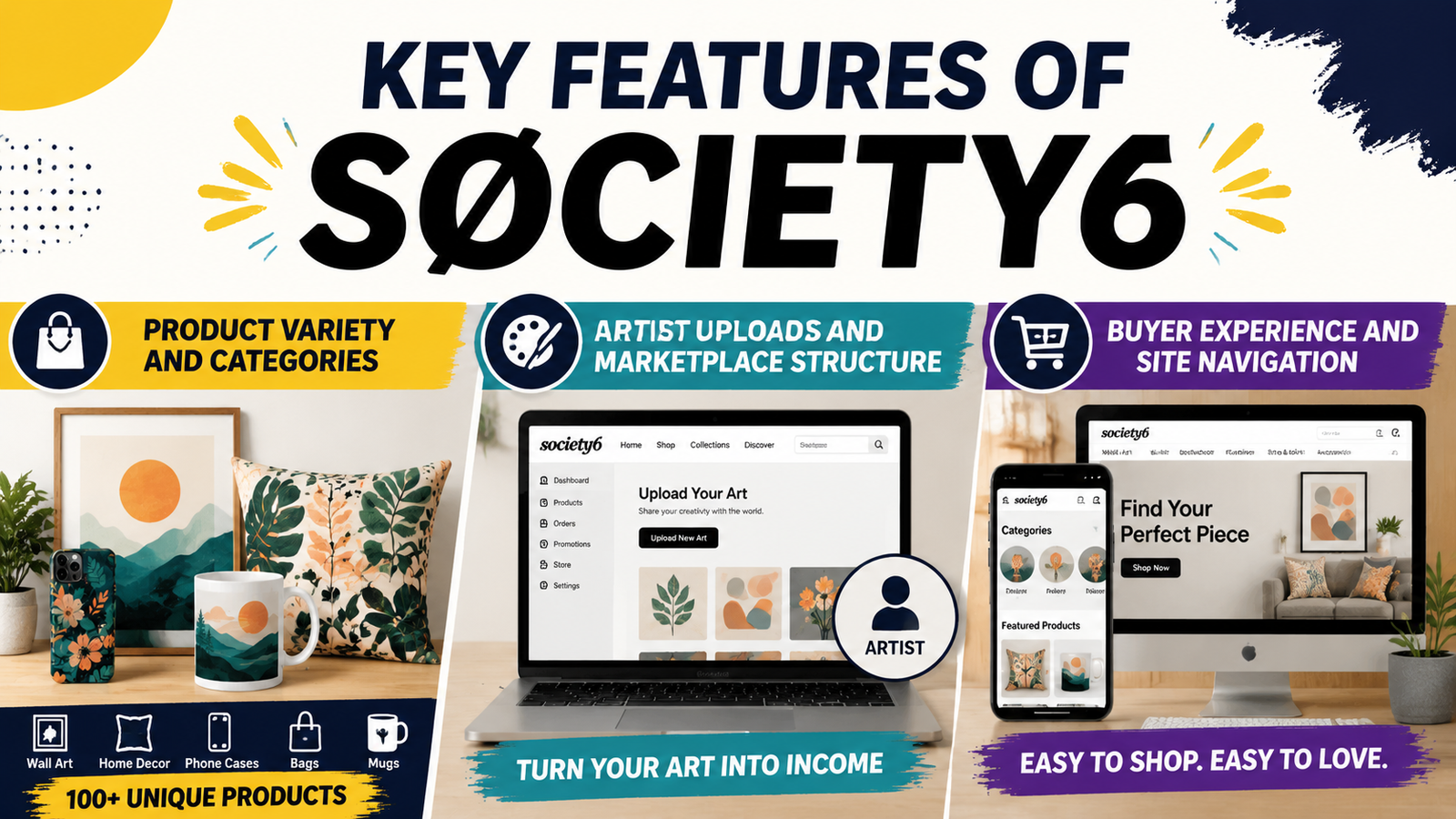
One of Society6’s biggest selling points is its extensive product catalog. Artists can apply their designs to:
- Wall art includes tapestries, posters, canvas prints, and framed prints.
- Home decor — pillows, rugs, duvet covers, shower curtains
- Lifestyle products — phone cases, mugs, laptop skins
- Accessories — tote bags, coasters, desk mats
- Limited furniture pieces
The breadth of product types makes Society6 versatile for both buyers and creators — from a single abstract print to a fully themed home decor set.
Artist Uploads and Marketplace Structure
Uploading designs on Society6 is free; there’s no upfront subscription to get started. Once submitted, artwork is placed across eligible product types and listed in the marketplace. Artists don’t control pricing or special promotions — Society6 standardizes some pricing to maintain a unified shopping experience.
However, product discoverability depends heavily on Society6’s internal marketplace algorithm and editorial surfaces — which many artists find opaque and competitive.
Buyer Experience and Site Navigation
Buyers see a curated selection of art‑driven products with filtering options by category, theme, and artist. While navigation is fairly straightforward, high shipping costs and delivery wait times (especially for larger items like rugs or framed art) are frequent points of customer feedback.
Pricing, Fees, and Value for Money
Artist Fees and Subscription Structure
Society6 does not charge artists a mandatory subscription — uploading is free. Some alternative platforms may offer optional paid tiers for analytics or promotional features, but in 2026 the baseline model remains free to join.
Product Pricing for Buyers
Products are typically positioned in the premium end of the POD market, which means higher retail tags. Combined with shipping costs, buyers often feel the total price — while reflective of artist creativity — may not always match perceived value, especially for basic items.
Customer Service and Support
Shipping and Delivery Experiences
Reviews repeatedly show ambivalence toward shipping: while some orders arrive smoothly and on schedule, others — especially larger items — can take several weeks or arrive damaged.
International delivery adds complexity for global customers, sometimes increasing wait times and shipping costs substantially.
Returns, Refunds, and Support Reputation
Society6 offers returns and refunds within a specified timeframe if products are defective or not as expected. Customer service is generally appreciated for responsiveness, but wait times and ongoing case follow‑ups can vary.
How ViparSpectra LED Grow Lights Improve Indoor Gardening
How Mixhers Supports Women’s Wellness and Daily Health Goals
Premier TEFL Review 2026: Courses, Certifications, and Career Opportunities
Why Travelers Choose Green Motion for Sustainable Car Rentals
MMOGA DE Review: Features, Pricing, and Gaming Benefits
Artist Experience – The Good, Bad, and Reality
Discoverability and Marketplace Challenges
Artists often struggle with visibility on Society6’s platform. Since there are no guaranteed promotional tools built into the free model and the marketplace is crowded, many designs never see traffic without external marketing support.
This means most sellers will need to promote their Society6 shops via social media, blogs, or email lists to generate consistent traffic and sales.
External Marketing and Social Promotion
Artists with large followings or savvy promotional strategies often outperform those relying solely on Society6’s internal discovery mechanisms. For many, it becomes one channel among several — alongside Redbubble, Etsy, or direct storefronts — rather than a standalone income generator.
Advantages of Selling on Society6
Key Advantages:
- No inventory management required.
- No need to handle shipping or customer service.
- Free to start selling.
- Large global customer base.
- Wide range of product categories.
- Opportunity to earn passive income.
- Professional manufacturing and fulfillment.

Disadvantages of Selling on Society6
Common Drawbacks:
- Low royalty percentages on many products.
- High competition among artists.
- Limited control over product pricing.
- Dependence on Society6’s search algorithm.
- Difficult for new artists to gain visibility.
- Earnings may be inconsistent.
Alternatives and Competitors
Redbubble and Etsy Comparisons
Redbubble typically offers higher artist margin flexibility and broader product variety, especially in stickers and apparel. Etsy caters more to handmade or personalized art and allows pricing control and direct customer interaction.
Society6’s advantage is its curated, home‑decor‑centric focus, but that specialization also makes it a narrower choice for some artists.
Who Should Use Society6 in 2026
Ideal Users
- 🔹 Artists focused on home decor and prints
🔹 Sellers with an existing audience
🔹 Creators seeking a passive income stream
🔹 Buyers looking for unique art pieces
- 🔹 Artists focused on home decor and prints
Users Who Might Want Alternatives
- 🔸 Artists seeking high per‑item earnings
🔸 Sellers without promotional channels
🔸 Buyers who prioritize consistent quality over uniqueness
- 🔸 Artists seeking high per‑item earnings
Conclusion
In 2026, Society6 remains a legitimate and valuable platform — especially for artists wanting a hands‑off print‑on‑demand sales channel and buyers hunting for unique designs.
However, the low royalty structure, inconsistent product quality, and competitive discoverability mean it isn’t a slam‑dunk choice for everyone. Artists should be prepared to drive traffic, manage expectations around earnings, and use Society6 as a complementary channel, not a sole business strategy.
Buyers should weigh product uniqueness against shipping times and price — and consider reading reviews on specific products before ordering. With realistic expectations and strategic use, Society6 can still be a meaningful part of creative commerce in 2026.
Frequently Asked Questions
Q. Is Society6 legit and safe to use?
Yes — Society6 is a legitimate online marketplace owned by reputable parent companies and has been operating since 2009.
Q. How much do artists actually earn on Society6?
Artists typically earn around 10% on most products, with a bit more flexibility on art prints. Most need high traffic to generate meaningful revenue.
Q. Are products on Society6 good quality?
Quality varies — prints and framed art are often reliable, but home decor and accessories show inconsistent feedback.
Q. Does Society6 charge artists any fees?
Uploading and selling is free; there’s no mandatory subscription fee to participate.
Q. Should I sell on Society6 or use alternatives?
If decor and print sales fit your style and you have marketing channels, Society6 can complement your strategy. Otherwise, consider Redbubble or Etsy for more control.

Recent Post

Exploring Smarter Personal Data Protection Strategies with Incogni

Understanding Modern Crypto Finance Solutions and the Role of Nexo

Key Factors to Know Before Exploring Bellway Products

Exploring Modern Beauty Tools and the Growing Appeal of Luxie

How Innovative Consumer Products Are Changing With Dip Devices

What Makes Creative Haircare Stand Out With IGK Hair?

A Beginner-Friendly Guide to Understanding R+R Medicinals CBD

A Complete Guide to Choosing the Right Products From R+Co

A Complete Guide to Building a Simple Routine With Bubble Skincare
Releted Post