



How Kiwi.com Finds the Cheapest Flights for Travelers
Discover how Kiwi.com finds the cheapest flights using advanced algorithms, virtual interlining, and smart route combinations. Learn how Kiwi.com helps travelers save money by uncovering hidden deals and flexible travel options that traditional booking platforms often miss.
Table of Contents
- 1 Introduction to Kiwi.com
- 2 Why Travelers Trust It for Cheap Flights
- 3 The Core Technology Behind Kiwi.com
- 4 How Kiwi-Code Algorithm Works
- 5 Key Strategies Kiwi.com Uses to Find Cheap Flights
- 6 Unique Features That Save Money
- 7 Role of Big Data and AI
- 8 Pros and Cons of Using Kiwi.com
- 9 Comparison with Other Flight Search Engines
- 10 How Kiwi.com Compares to Google Flights and Skyscanner
- 11 Step-by-Step Guide: How to Use Kiwi.com Effectively
- 12 Hidden Travel Hacks Used by Kiwi.com
- 13 When Should You Avoid Using Kiwi.com?
- 14 Real-Life Example: How Kiwi.com Saves Money
- 15 Is Kiwi.com Safe and Reliable for Booking Flights?
- 16 Expert Tips to Maximize Savings on Kiwi.com
- 17 Conclusion
- 18 Frequently Asked Questions
Introduction to Kiwi.com
What Makes Kiwi.com Different
If you’ve ever spent hours jumping between airline websites trying to find the cheapest flight, you already know how frustrating the process can be. This is where Kiwi.com steps in and flips the entire system on its head. Unlike traditional flight search engines that only show results based on airline partnerships, Kiwi.com digs deeper—much deeper. It uses advanced algorithms to uncover routes and combinations that most platforms simply cannot see.
What makes this platform truly fascinating is its ability to think outside the airline industry’s traditional rules. Airlines usually operate within alliances or partnerships, meaning they only coordinate flights with specific carriers. Kiwi.com ignores those boundaries and builds entirely new routes by combining flights from airlines that don’t even collaborate. This innovative approach opens up a massive pool of possibilities, often leading to significantly cheaper travel options.
The result? Travelers get access to routes that are not only cheaper but sometimes faster or more flexible as well. It’s like having a travel hacker working behind the scenes, constantly scanning for better deals and smarter ways to get you from point A to point B.
Why Travelers Trust It for Cheap Flights
Trust doesn’t come easily when it comes to booking flights—after all, you’re spending your hard-earned money. Kiwi.com has built credibility by consistently delivering lower prices compared to traditional booking platforms. The secret lies in its ability to process over 100 million flight searches daily, analyzing vast amounts of data to find the best deals.
Think of it like a super-powered comparison engine that doesn’t just compare—it creates entirely new travel options. Many users are drawn to its ability to uncover “hidden deals” that are invisible on other platforms. This includes unconventional routes, mixed airlines, and even clever pricing tricks that exploit airline pricing inconsistencies.
At its core, Kiwi.com appeals to modern travelers who value flexibility and savings over rigid itineraries. Whether you’re a student backpacking across Europe or a business traveler trying to cut costs, the platform offers something uniquely powerful.
The Core Technology Behind Kiwi.com
What is Virtual Interlining
The backbone of Kiwi.com’s success is something called virtual interlining—a concept that has completely transformed how flights are booked. Traditionally, airlines create connections through formal agreements known as interlining. This allows passengers to book multiple flights under one ticket, with baggage and schedules coordinated between airlines.
Virtual interlining throws that rulebook out the window. Instead of relying on airline partnerships, Kiwi.com’s system connects flights independently, even if the airlines have no relationship whatsoever.
This means you can fly from one airline to another without them officially coordinating your journey. The platform handles the complexity behind the scenes, stitching together a seamless itinerary from completely unrelated carriers.
Difference Between Traditional and Virtual Interlining
Feature | Traditional Interlining | Virtual Interlining |
Airline Partnerships | Required | Not required |
Route Options | Limited | Extremely flexible |
Pricing | Often higher | Usually cheaper |
Booking Complexity | Simple | Managed by platform |
Virtual interlining opens up a whole new world of travel possibilities. It allows airports to act like “virtual hubs,” enabling connections that were previously impossible.
How Kiwi-Code Algorithm Works
Behind virtual interlining lies Kiwi.com’s proprietary Kiwi-Code algorithm, a system designed to find the cheapest possible travel combinations. This algorithm doesn’t just search—it experiments, tests, and optimizes.
For example, if a one-way ticket is more expensive than a round trip, the algorithm might include a return segment in your itinerary—even if you don’t plan to use it. Sounds strange? Maybe. But it works.
The algorithm also considers:
- Multiple airlines (over 800 carriers)
- Different airports near your destination
- Alternative travel routes
- Price fluctuations in real time
It’s essentially solving a massive optimization problem—finding the cheapest way to connect flights across the globe.
Key Strategies Kiwi.com Uses to Find Cheap Flights
Combining Non-Partner Airlines
One of the biggest cost-saving tricks Kiwi.com uses is combining flights from airlines that don’t normally work together. Traditional platforms ignore these combinations because they rely on airline agreements. Kiwi.com embraces them.
Imagine flying from Delhi to Paris using three different budget airlines that don’t coordinate. Booking this manually would be a nightmare. Kiwi.com automates it, turning chaos into opportunity.
Multi-City and Hidden City Ticketing
Ever heard of “hidden city ticketing”? It’s a clever hack where you book a flight with a layover in your desired destination and simply skip the final leg. Kiwi.com identifies these opportunities automatically.
It also offers multi-city planning tools that optimize routes across several destinations, often reducing overall costs significantly.
Using Alternative Airports
Sometimes flying into a nearby airport instead of your main destination can save a lot of money. Kiwi.com scans surrounding airports and suggests cheaper alternatives.
For example, instead of flying directly into London Heathrow, it might recommend Gatwick or even a nearby city with a cheaper connection.
Flexible Dates and Routes Optimization
Airfare prices change constantly. Kiwi.com uses flexible date searches to identify the cheapest days to travel. Statistically, mid-week flights—especially Tuesday and Wednesday—tend to be cheaper.
Unique Features That Save Money
Nomad Tool for Multi-Destination Trips
The Nomad feature is like having a travel planner powered by AI. It calculates every possible route combination for multi-city trips and selects the cheapest one.
Price Alerts and Deals
Users can set alerts and get notified when prices drop, ensuring they never miss a deal.

Kiwi.com Guarantee
Since virtual interlining involves separate tickets, missed connections can be a concern. Kiwi.com offers a guarantee that covers disruptions, giving travelers peace of mind.
Role of Big Data and AI
Real-Time Price Scanning
Kiwi.com performs billions of price checks daily, analyzing a massive dataset of flight information. This allows it to react instantly to price drops and new deals.
Think of it as a financial trading system—but for flights.
Predictive Pricing and Trends
The platform doesn’t just react—it predicts. By analyzing historical data and trends, it can suggest when to book and when to wait.
Pros and Cons of Using Kiwi.com
Advantages
Kiwi.com offers unmatched flexibility and pricing advantages. It unlocks routes that other platforms simply cannot access, often resulting in significant savings.
Limitations
However, there are trade-offs. Self-transfer flights may require re-checking baggage, and delays can be more complex to handle without the guarantee.
Radical Storage: A Complete Guide to Luggage Storage Solutions in 2026
How to Shop Smartly on Printerval LLC (Complete Guide)
HelloFresh – US Groceries Review 2026: Is It Worth the Price?
How to Start with Crypto.comInvestment for Beginners (Step-by-Step Guide)
How to Join the Best Study group Darmstadt DE for Academic Success
Comparison with Other Flight Search Engines
Feature | Kiwi.com | Traditional OTAs |
Airline Combinations | Unlimited | Limited |
Price Optimization | Advanced | Basic |
Route Flexibility | High | Moderate |
Hidden Deals | Yes | Rare |
How Kiwi.com Compares to Google Flights and Skyscanner
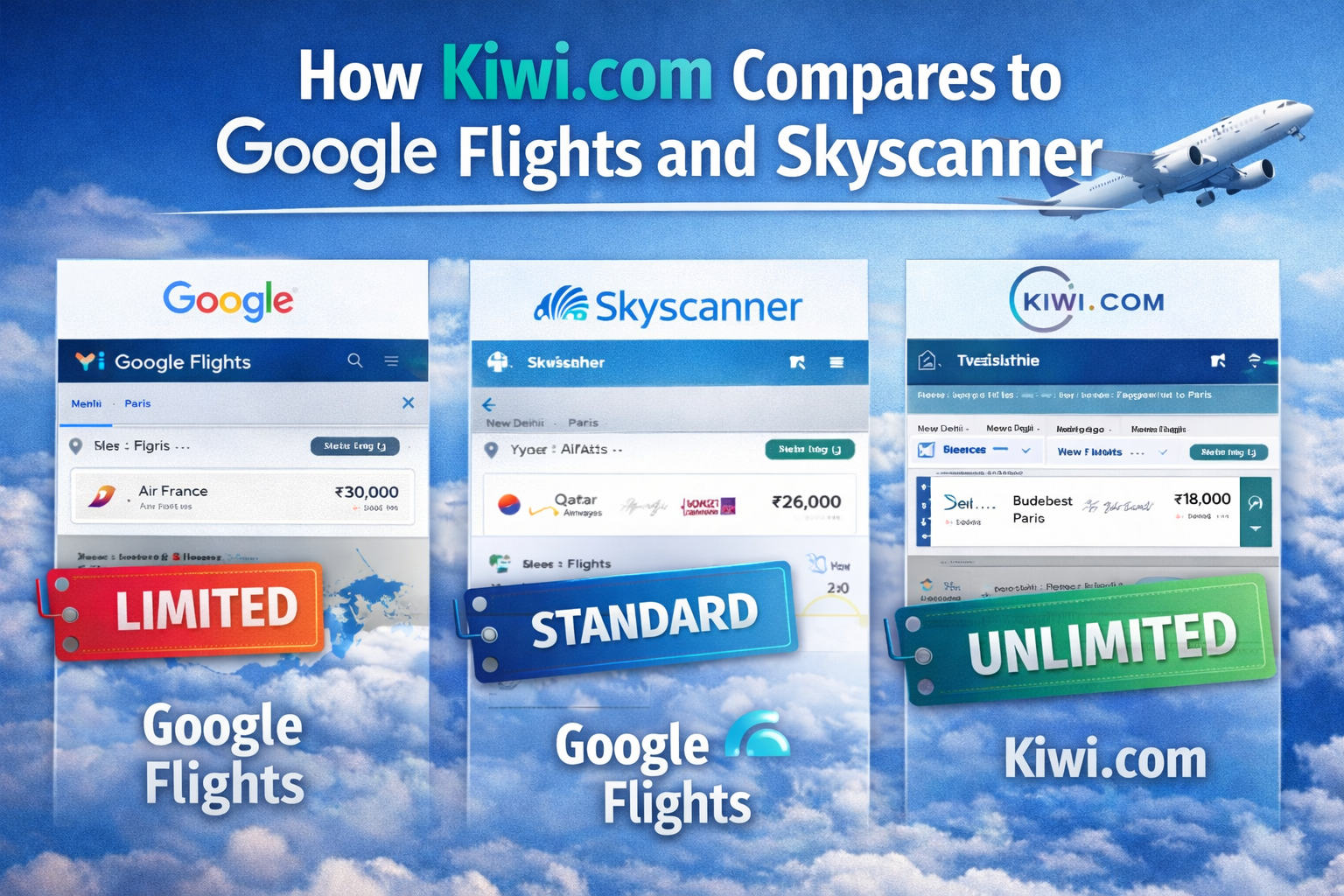
When people search for cheap flights, platforms like Google Flights and Skyscanner usually come to mind. But Kiwi.com operates on a completely different level. While Google Flights focuses on speed and Skyscanner focuses on comparison, Kiwi.com focuses on innovation in route building.
Google Flights typically shows results based on airline partnerships, meaning you’re limited to standard routes. Skyscanner expands the search but still relies heavily on airline agreements. Kiwi.com, on the other hand, goes beyond both by combining non-partner airlines, which unlocks hidden routes and cheaper fares.
For example, a journey that costs ₹35,000 on Google Flights might appear for ₹22,000 on Kiwi.com simply because it mixes airlines creatively. This difference makes Kiwi.com especially valuable for travelers who prioritize savings over convenience.
Step-by-Step Guide: How to Use Kiwi.com Effectively
If you want to truly unlock the power of Kiwi.com, you need to use it strategically. It’s not just about typing your destination and booking the first result.
Start by entering your departure and destination cities, but keep your dates flexible. Kiwi.com performs best when you allow it to explore multiple date combinations. Use the “flexible dates” option to see cheaper alternatives.
Next, explore the map feature. Instead of locking yourself into one destination, try searching “Anywhere.” This allows Kiwi.com to suggest the cheapest destinations available from your location.
Finally, always review the itinerary details carefully. Since Kiwi.com often uses self-transfer flights, you need to check baggage policies and layover times. Adding a buffer between flights can save you from unnecessary stress.
Hidden Travel Hacks Used by Kiwi.com
One of the reasons Kiwi.com consistently finds cheaper flights is because it leverages travel hacks that most people don’t even know exist. These aren’t tricks in a shady sense—they’re simply smart ways of navigating airline pricing systems.
For instance, split ticketing is a common tactic. Instead of booking one expensive ticket, Kiwi.com breaks the journey into smaller segments that cost less when combined. Airlines price routes differently based on demand, and Kiwi.com takes advantage of these inconsistencies.
Another clever method is backtracking routes, where a slightly longer route ends up being cheaper than a direct one. It might sound counterintuitive, but airline pricing often doesn’t follow logic—it follows demand patterns.
When Should You Avoid Using Kiwi.com?
While Kiwi.com is powerful, it’s not always the perfect choice. Understanding when not to use it is just as important as knowing when to use it.
If you’re traveling for an urgent business trip or have tight schedules, Kiwi.com’s self-transfer routes may introduce risk. Delays in one flight could affect the next, especially if the airlines are not connected.
It’s also less ideal if you prefer premium airline services with seamless baggage transfers. Traditional bookings may offer more convenience in such cases.
That said, for flexible travelers, backpackers, and budget-conscious explorers, Kiwi.com remains one of the best tools available.
Real-Life Example: How Kiwi.com Saves Money
Let’s make this practical. Imagine you’re traveling from Delhi to Barcelona. A standard search on most platforms might show a direct or one-stop flight costing ₹40,000–₹50,000.
Now try the same route on Kiwi.com. You might find a combination like:
- Delhi → Abu Dhabi (Budget airline)
- Abu Dhabi → Milan (Low-cost carrier)
- Milan → Barcelona (Regional flight)
Total cost? Around ₹25,000–₹30,000.
Yes, it may take longer and involve multiple stops, but the savings can be huge. This is exactly how Kiwi.com changes the game—it prioritizes cost efficiency over traditional convenience.
Is Kiwi.com Safe and Reliable for Booking Flights?
Safety is one of the most common concerns when using platforms like Kiwi.com. The good news is that Kiwi.com has built a strong reputation over the years and serves millions of users globally.
One of its standout features is the Kiwi.com Guarantee, which protects travelers in case of missed connections or disruptions. This is especially important when dealing with self-transfer flights.
However, like any travel platform, it’s important to read the terms carefully. Understanding baggage rules, visa requirements, and layover conditions ensures a smooth experience.
Expert Tips to Maximize Savings on Kiwi.com
Finding cheap flights isn’t just about using the right platform—it’s about using it smartly. Always stay flexible with your dates and destinations. The more flexible you are, the more options Kiwi.com can generate for you.
Consider using nearby airports and multi-city searches. Don’t ignore slightly longer routes—they’re often significantly cheaper. And always check the details of your itinerary, especially when dealing with self-transfer flights.
Conclusion
Kiwi.com isn’t just another flight search engine—it’s a complete rethinking of how travel booking works. By leveraging virtual interlining, big data, and intelligent algorithms, it uncovers flight deals that most platforms simply cannot find.
It’s like having a travel hacker in your pocket, constantly searching for better routes, cheaper tickets, and smarter ways to explore the world. While it may require a bit more flexibility from the traveler, the savings and possibilities it unlocks are hard to ignore.
Frequently Asked Questions
Q. Is Kiwi.com safe to use?
Yes, Kiwi.com is widely used globally and offers a guarantee to protect travelers from disruptions.
Q. Why are flights cheaper on Kiwi.com?
Because it combines airlines that don’t normally work together and uses advanced algorithms to find cheaper routes.
Q. What is virtual interlining?
It’s a system that connects flights from different airlines without formal agreements to create cheaper itineraries.
Q. Can I trust self-transfer flights?
Yes, but it’s important to allow enough time between connections or use Kiwi’s guarantee.
Q. Does Kiwi.com show all airlines?
It covers a vast range—over 800 carriers—making it one of the most comprehensive search engines available.

Recent Post

Key Factors to Know Before Exploring Bellway Products

Exploring Modern Beauty Tools and the Growing Appeal of Luxie

How Innovative Consumer Products Are Changing With Dip Devices

What Makes Creative Haircare Stand Out With IGK Hair?

A Beginner-Friendly Guide to Understanding R+R Medicinals CBD

A Complete Guide to Choosing the Right Products From R+Co

A Complete Guide to Building a Simple Routine With Bubble Skincare

The Essential Guide to Understanding and Building a Legacy

Key Benefits of Choosing Water Filtration Products From Waterdrop (US)
Releted Post