
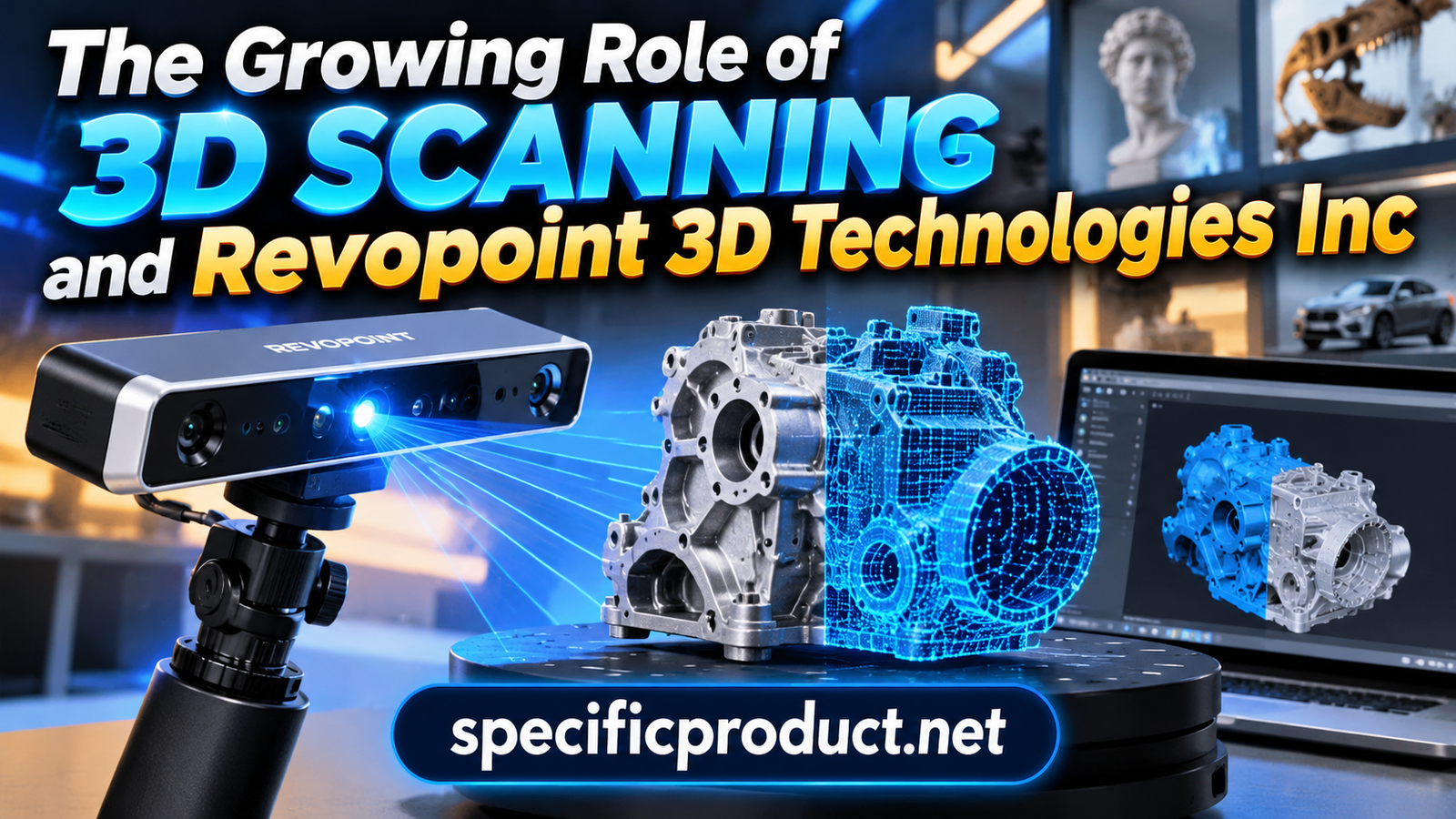


Discover how Revopoint 3D Technologies Inc is contributing to the growing world of 3D scanning technology. This article explores the uses of 3D scanners in manufacturing, reverse engineering, 3D printing, automotive design, healthcare, and digital modeling, along with the latest developments shaping the future of 3D scanning.
Table of Contents
3D scanning is the process of capturing the shape, size, and sometimes color of a real-world object and turning that information into a digital 3D model. Instead of measuring every curve, corner, hole, and surface by hand, a scanner uses cameras, structured light, lasers, or other optical methods to collect large amounts of spatial information. The result can be a point cloud, mesh, or textured 3D model that can later be edited, measured, printed, inspected, or imported into CAD software. It is similar to creating a detailed digital representation of a real-world object. This approach is becoming increasingly useful because companies need faster ways to move between physical products and digital design environments. The global 3D scanning market was estimated at about $4.28 billion in 2024 and is projected by Grand View Research to reach about $7.51 billion by 2030, representing a projected 10.1% CAGR from 2025 to 2030. That growth reflects wider use in manufacturing, engineering, healthcare, construction, automotive work, and other fields. Modern scanners are also becoming easier to use, which means the technology is no longer limited to large laboratories or highly specialized measurement departments.
The basic process behind 3D scanning is easier to understand than it may first appear. A scanner observes an object from one or more positions and records information about its surfaces, using a technology such as structured light or laser projection. Software then combines the captured data into a larger model, correcting alignment and filling areas where possible. Depending on the scanner and the object, users may apply markers, use surface features for tracking, rotate the object on a turntable, or move the scanner around the object manually. After scanning, the raw information normally goes through processing steps such as point-cloud generation, alignment, fusion, meshing, and texture processing. The finished model can then be exported into common formats such as STL, OBJ, PLY, FBX, GLTF, or 3MF, depending on the software and workflow. Revopoint’s current software ecosystem supports several of these formats and provides tools for scanning, post-processing, alignment, and model export. This makes 3D scanning more than simply taking a digital photograph. A normal photograph records appearance from one viewpoint, while a 3D scan attempts to capture the physical geometry needed for digital design, measurement, reproduction, or inspection.
The growing interest in 3D scanning is closely connected to the larger movement toward digital manufacturing and faster product development. Businesses want to reduce repetitive manual work, shorten design cycles, and make better use of existing physical objects. Traditional measurement methods can still be useful, but complex parts may contain curves, hidden transitions, irregular surfaces, and many small features that are difficult to capture efficiently with rulers, calipers, or manual drawings alone. A 3D scanner can capture many of these details in a relatively short scanning session and provide a digital starting point for later work. This is especially helpful when the original CAD file does not exist. The technology also fits naturally with other digital tools such as CAD, 3D printing, simulation, digital inspection, virtual reality, and computer vision. Grand View Research identifies technological advances, increased research spending, and wider use of structured-light technology among factors supporting market growth. As scanning hardware becomes more portable and software becomes more capable, the barrier to adoption can become lower. A designer, engineer, technician, educator, or creator can now consider scanning as part of a normal workflow instead of treating it as a rare specialist activity.
Manual measurement is not disappearing, but 3D scanning changes what happens after measurement. Imagine an engineer working with an old machine part for which no original drawing exists. The traditional approach might involve measuring individual dimensions, drawing the part, checking the measurements, and repeating the process when something does not fit. With scanning, the engineer can create a digital representation of the physical component first and then use that model as a reference for further work. Revopoint describes this type of workflow in its reverse-engineering applications, where scanned objects can be transformed into models suitable for CAD-based modification and manufacturing. This does not mean every scan is automatically perfect or ready for production. The quality of the final result depends on scanner selection, surface conditions, scanning technique, alignment, calibration, software processing, and the required tolerance. Still, the central advantage is clear: instead of starting with a blank digital screen, the user starts with real physical geometry. That can save time and provide a much closer connection between what exists in the workshop and what appears in the computer.
3D scanning is now connected with many parts of the product lifecycle. During product development, it can help designers study existing products, compare prototypes, and capture physical references. During manufacturing, it can support inspection and quality-control workflows by comparing scanned parts against expected geometry. During maintenance and repair, scanning can help technicians understand worn, damaged, or unusual components. In education, it can give students a practical way to explore geometry, engineering, digital manufacturing, and computer-aided design.
Manufacturing is one of the clearest areas where 3D scanning can create practical value. Engineers may need to inspect a manufactured part, reproduce an unavailable component, compare a prototype with a digital design, or understand the shape of an existing product. A scan can provide detailed geometric information that can then be used for inspection, modification, or reverse engineering. Revopoint’s industrial range now includes blue-laser and structured-light systems aimed at small and medium workpieces, including the MetroX and MetroY families. The MetroX series, for example, combines multi-line laser scanning with full-field blue structured light and is designed for small to medium objects. The technology can be particularly useful where surfaces are dark, shiny, complex, or difficult to measure with basic tools, although actual results still depend on the material and scanning mode. Industrial scanning is therefore not simply about obtaining a visually attractive model.
Healthcare, automotive work, and education show how widely 3D scanning can be applied outside traditional factory measurement. In healthcare-related workflows, detailed scans may support customized solutions where physical dimensions need to match an individual object or body area. Automotive professionals can scan vehicle parts and surrounding geometry before designing modifications, replacements, or repairs. Revopoint specifically highlights vehicle modification as an application where scanning can reduce reliance on repeated manual measurements and help create digital representations of parts.
Revopoint 3D Technologies Inc. is a company focused on 3D scanning and 3D vision technologies. According to the company’s official history, development work began in 2014 with a team of researchers and doctors, and Revopoint 3D Technologies Inc. was established in 2019 as an international entity serving the U.S. and wider global markets. The company says it focuses on developing accurate, user-friendly, and cost-conscious 3D scanning products. Its current brand story describes a broader focus on 3D vision, AI, optical technologies, and what it calls embodied intelligence. Revopoint’s product portfolio has expanded considerably over time, moving from earlier consumer-oriented scanners into portable professional systems and more industrial-focused products.
Revopoint’s development approach places strong emphasis on optical hardware, scanning algorithms, software, and AI-assisted processing. The company says its team includes researchers and engineers and that it invests heavily in research and development. Its current brand information reports 140+ patents, 300+ global employees, and market coverage in more than 150 countries and regions. These are company-reported figures and should be understood in that context rather than as independent market rankings. The company’s product history also shows a steady move from early handheld systems toward more specialized industrial and optical-tracking technologies. This progression matters because 3D scanning is not one single technology.
Revopoint’s current product range is broad enough that choosing a scanner requires understanding the actual task rather than simply looking for the scanner with the highest specification. The company currently promotes industrial-grade models such as MetroY Ultra, MetroY, MetroY Pro, and MetroX, along with standalone systems including MIRACO Plus. Its product store also lists POP 3 Plus, MIRACO, MINI 2, Trackit, Trackit SR, and related software products. This variety can be useful because a small detailed component does not necessarily require the same scanner as a large mechanical structure.
Portable scanners have changed the practical side of 3D scanning because the user can bring the scanner to the object instead of always bringing the object to a dedicated scanning station. Revopoint’s MIRACO family is an example of this approach. The current MIRACO Plus is described as an all-in-one scanner for small to large objects, with a listed single-frame accuracy of up to 0.04 mm and scanning speeds of up to 20 frames per second. The company currently lists a sale price of $1,869, compared with a regular price of $2,199 on its store page at the time of the search. Prices can change, and taxes, shipping, regional offers, and software bundles can affect the final cost. Standalone operation can also reduce the need to keep a computer physically connected during scanning, which can be useful in workshops or field environments.
The industrial side of Revopoint’s lineup focuses more heavily on precision, repeatability, surface handling, and measurement workflows. The MetroY Ultra, for example, is designed for small to medium workpieces and supports multiple blue-light scanning modes. Revopoint lists up to 0.015 mm single-frame accuracy, 0.015 + 0.04 mm × L volumetric accuracy, up to 3 million points per second in multi-line laser mode, and up to 7 million points per second in full-field structured-light mode. It also offers an optional CMM edition with a ball plate and Revo Measure software for on-site accuracy verification.
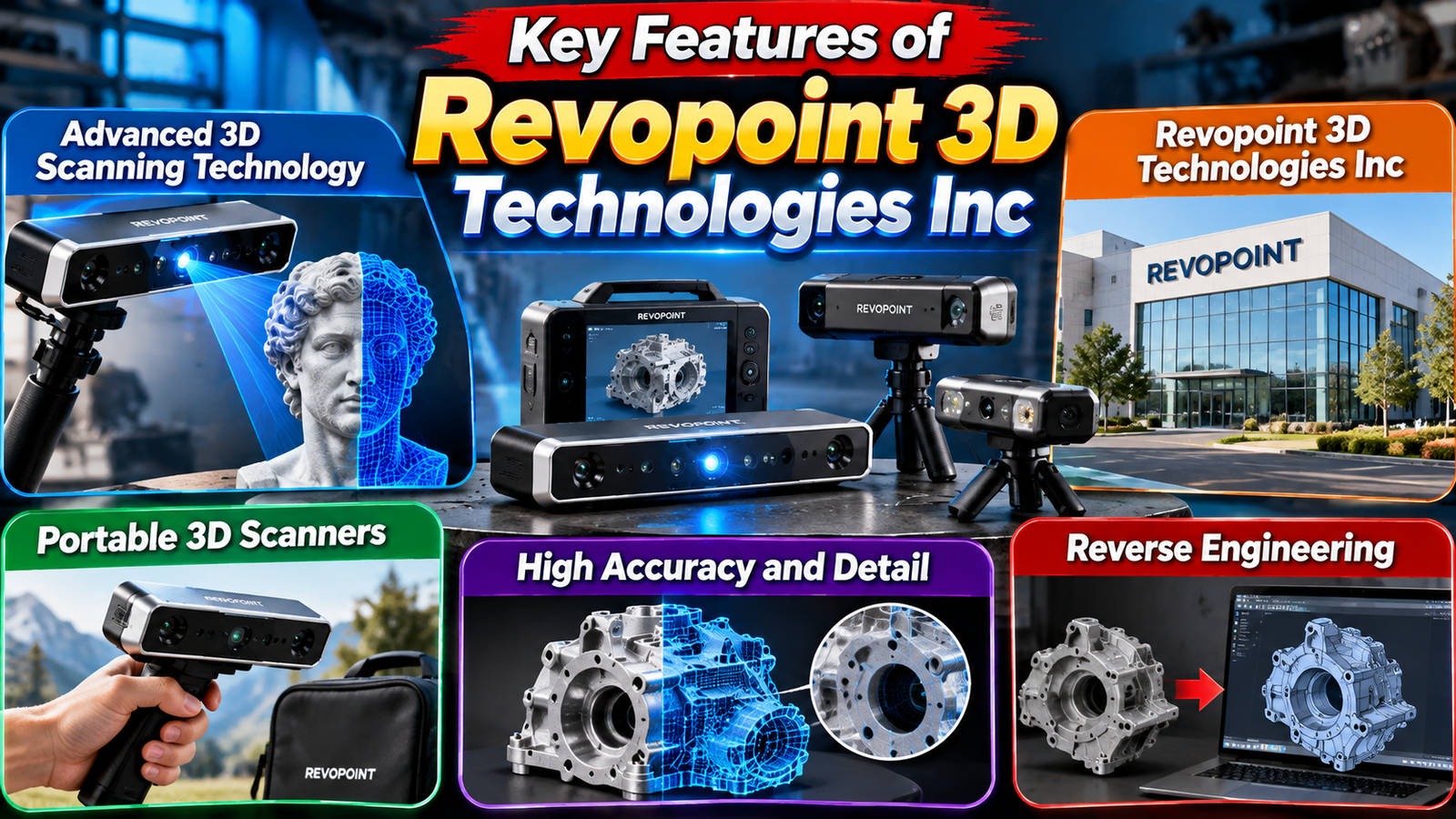
Reverse engineering is one of the most natural applications for 3D scanning. When an original CAD model is missing, an engineer still needs a way to understand the physical part before changing or reproducing it. Revopoint describes scanning as a way to create digital representations of existing objects that can be imported into CAD workflows. The process normally starts by preparing the object and selecting an appropriate scanning mode. The scanner captures multiple views, and software aligns the captured data into a unified model. After cleanup and mesh generation, the user can inspect dimensions, identify design features, or move the data into CAD software for further work. This can be particularly valuable for older machinery, replacement parts, customized equipment, and product development. It does not magically recreate design intent, material properties, internal structures, or manufacturing tolerances that cannot be observed from the outside.
3D printing and 3D scanning work together naturally because scanning converts physical geometry into a digital model, while 3D printing converts digital geometry back into a physical object. This creates a simple physical-digital-physical cycle. A user can scan a component, clean the model, make changes in CAD or mesh software, and then send the resulting file to a 3D printer. Revopoint specifically positions its scanners for creating models that can be imported into 3D-printing slicers.
Automotive work is another area where 3D scanning can provide a practical advantage. Vehicle components often have complex curves and must fit within limited spaces, making manual measurement slow and sometimes difficult. A scan can capture the geometry of a bumper, bracket, interior component, engine-bay area, motorcycle part, or other accessible structure and create a digital reference. Revopoint highlights vehicle modification as one of its applications, explaining that scanning can support repair, reproduction, prototyping, and quality-control work. A digital model can then be used to design a new component or compare an existing part with another design. For example, a custom bracket can be designed around scanned geometry rather than relying only on estimated measurements. This can help reduce repeated trial-and-error during prototyping.
The ability to capture detailed physical geometry also makes 3D scanning relevant to healthcare and cultural preservation. In healthcare-related applications, scanning can help create digital representations that support customized designs, provided that the equipment, workflow, privacy requirements, and professional standards are appropriate for the specific application. Revopoint lists healthcare as one of its use cases, including customized solutions based on detailed scans of body parts or dental molds. Cultural preservation is another interesting area because scanning can create a digital record of objects that may be fragile, rare, or difficult to handle repeatedly.
Photography Styling Trends and the Role of KATE BACKDROP INC
How Connected Home Technology Is Evolving With eufy | Fantasia Trading LLC
Key Factors to Know Before Exploring Bellway Products
The Powerful Lessons About Resilience We Can Learn From The Phoenix
Peanut Butter & Co.: A Complete Guide to Delicious Peanut Butter
Hardware is only half of a modern 3D-scanning system. The software determines how efficiently the captured data can become a useful model. Revopoint currently provides software such as Revo Scan, Revo Metro, Revo Track, Revo Design, and Revo Measure, each aimed at different parts of the scanning workflow. Its support documentation states that Revo Scan and related tools support common formats including PLY, OBJ, and STL, while additional export options include ASC, FBX, GLTF, and 3MF depending on the model type. Revo Metro is positioned around professional scanning and processing, while Revo Measure is designed for measurement and deviation analysis. Current software support also covers Windows, macOS, Android, and iOS for applicable scanner families, although industrial models have more specific platform requirements.
Three factors often shape a user’s experience with a 3D scanner: accuracy, speed, and ease of use. Accuracy describes how closely the captured data represents the real object’s dimensions under defined conditions. Speed affects how quickly the scanner can capture points or frames and how much time the user spends completing a project. Ease of use includes tracking, calibration, scanning modes, software controls, file management, and the amount of preparation required. Revopoint’s newer products show how these areas are developing together. The MetroY Ultra, for example, lists up to 3 million points per second in multi-line laser scanning and up to 7 million points per second in full-field structured-light scanning.
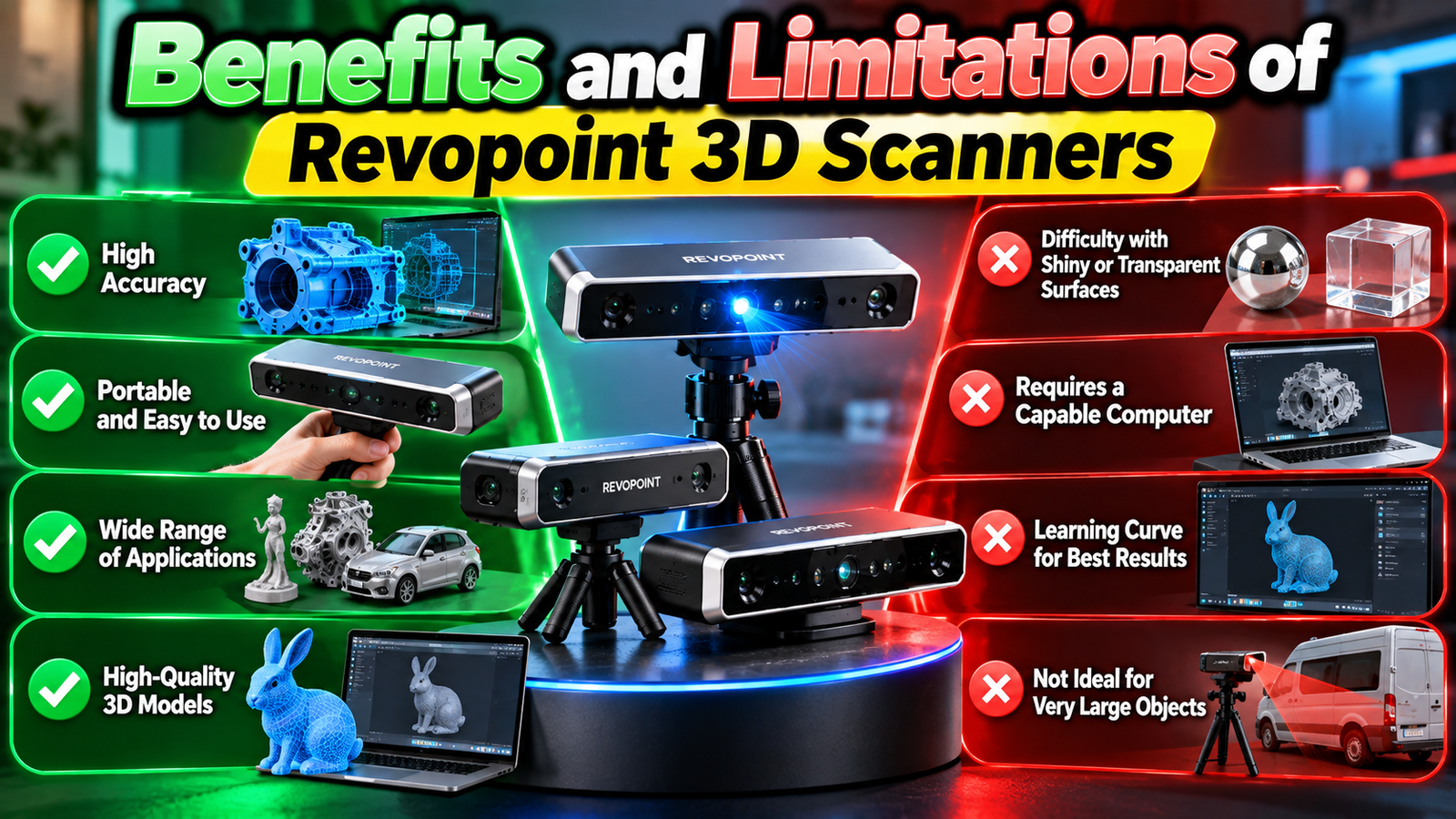
Revopoint scanners can offer several practical advantages, especially for users who want to move quickly between physical objects and digital models. Portable designs can make scanning easier in workshops and field environments, while different product families provide options for small components, medium-sized objects, and larger workpieces. The company also provides software for scanning, measurement, CAD-related workflows, and model processing. Its current industrial products offer combinations of blue laser scanning and structured light, while optical-tracking systems provide another approach for larger or more complex objects. There are limitations too. High-performance scanning may require a powerful computer, and Revopoint’s published system requirements for several newer industrial models include modern processors, substantial RAM, and, in some laser workflows, NVIDIA graphics hardware.
Revopoint’s 2026 product developments show an important direction for the company: moving from general-purpose 3D scanning toward more specialized systems for industrial measurement, outdoor scanning, optical tracking, and AI-assisted 3D vision. According to the company’s current brand history, 2026 launches include MetroY Ultra, POP 4, and Trackit SR. Trackit SR is especially notable because it combines a wireless scanner with an optical tracking system and supports a recommended part-size range of 0.01 to 4 meters. Revopoint lists up to 0.02 mm single-frame accuracy, up to 2 million points per second, Wi-Fi 6, and a tracking volume of 3 cubic meters for the system. MetroY Ultra takes another direction, emphasizing measurement and inspection with multiple scanning modes, high scanning speed, and a CMM-oriented verification option.
Choosing a Revopoint scanner should begin with the job, not the product name. First, consider the size of the object because a scanner designed for small parts will not necessarily be appropriate for a large vehicle component or machine structure. Next, consider the required accuracy. A hobbyist creating a decorative model may have very different requirements from an engineer performing dimensional inspection. Surface type is also important because shiny, black, transparent, or reflective objects can require special scanning methods or preparation. The environment matters as well: indoor studio scanning, workshop scanning, and outdoor scanning can present different lighting challenges. Finally, consider the final output. If the goal is 3D printing, STL or 3MF may be central to the workflow, while reverse engineering may require CAD conversion and measurement tools.
The future of 3D scanning is likely to be shaped by the combination of better sensors, faster processing, artificial intelligence, robotics, and easier software. Instead of producing only a raw point cloud, future systems can increasingly help users recognize surfaces, remove unwanted data, align scans, measure deviations, and convert physical geometry into useful digital assets with fewer manual steps. Revopoint’s current brand strategy already connects 3D vision with AI and embodied intelligence, while its newer products demonstrate a move toward specialized industrial scanning and tracking.
3D scanning is becoming an important link between the physical and digital worlds. Its applications now extend from reverse engineering and manufacturing to 3D printing, vehicle modification, healthcare, education, creative design, and cultural preservation. The growth of the global market, together with improvements in structured light, laser scanning, optical tracking, software, and AI, shows that the technology is moving into a wider range of everyday professional workflows. Revopoint 3D Technologies Inc. is part of this development, with a product portfolio that now includes portable scanners, standalone systems, industrial blue-light scanners, metrology-oriented products, and optical-tracking solutions.
3D scanning is used to capture the geometry of physical objects and create digital models. Common applications include reverse engineering, quality inspection, 3D printing, product development, vehicle modification, healthcare-related customization, cultural preservation, and digital design. The exact application depends on the scanner's accuracy, scanning range, software, and tracking capabilities.
Revopoint 3D Technologies Inc. is a company focused on 3D scanning and 3D vision technologies. The company says it was established in 2019 as an international entity after its technology development began in 2014. Its current product range includes portable, standalone, industrial, and optical-tracking 3D scanning systems.
Revopoint's industrial range includes the MetroX, MetroX Pro, MetroY, MetroY Pro, MetroY Ultra, and Trackit families. The appropriate model depends on object size, required accuracy, surface type, scanning environment, and measurement needs. MetroY Ultra, for example, is specifically positioned around measurement and inspection workflows.
Yes. Revopoint positions several scanners for creating digital models that can be processed and imported into 3D-printing workflows. Users can export compatible files such as STL, OBJ, or 3MF, depending on the software and model type. Some models may require additional cleanup or editing before the file is ready for printing.
3D scanning is already an important tool in many reverse-engineering workflows. It can provide a digital representation of an existing part when original CAD data is unavailable, helping engineers inspect, modify, or reproduce physical components. The final quality still depends on scanning conditions, accuracy requirements, software processing, and engineering validation.
Recent Post
The Growing Role of 3D Scanning and Revopoint 3D Technologies Inc

Why Fitness Fashion Lovers Are Exploring WISKII ACTIVE LIMITED

Improving Website Performance and User Experience With Strategy11

Website Design Trends and the Growing Role of Weblium.com

Photography Styling Trends and the Role of KATE BACKDROP INC
A Guide to Finding Everyday Fashion Inspiration on rihoas.com

How Connected Home Technology Is Evolving With eufy | Fantasia Trading LLC

A Closer Look at Modern Nutrition Trends With Real Health Supplements LTD

Family History Research Made More Accessible Through MyHeritage

Modern Outdoor Gear Trends and the Growing Appeal of Noxgear
Releted Post