monday.com Marketing Strategy: How Work Management Tools Scale
monday.com Marketing Strategy: How Work Management Tools Scale explores how monday.com uses product-led growth, content marketing, branding, and customer-centric positioning to scale globally. This article breaks down the key marketing tactics behind monday.com’s success and offers practical insights for SaaS founders and digital marketers looking to grow work management tools efficiently.
Introduction: The Rise of Work Management Platforms
Today’s workplace is very different from what it was ten years ago. Teams are remote, projects are complex, and speed is everything. In this chaos, work management tools have become the backbone of modern organizations. Among them, monday.com has carved out a powerful position—not just through product innovation, but through a smart, scalable marketing strategy.
So how does a work management platform grow from a simple task tracker into a global SaaS giant used by teams across industries? Let’s break it down, layer by layer.
Understanding monday.com as a Brand
At its core, monday.com isn’t selling software—it’s selling clarity. The brand positions itself as a flexible Work OS that adapts to how teams actually work, not the other way around. This positioning allows the company to market itself across use cases like project management, CRM, HR, marketing operations, and software development without being boxed into a single category.
That flexibility is gold from a marketing perspective.
Core Value Proposition of monday.com
monday.com’s messaging consistently revolves around three promises:
Visibility – Everyone knows what’s happening
Customization – Build workflows without code
Scalability – Start small, grow big
Instead of leading with technical jargon, the marketing focuses on outcomes: fewer meetings, faster execution, and less chaos. Simple problems, clear solutions.
Target Audience Segmentation Strategy
One reason monday.com scales so well is because it doesn’t rely on a “one-size-fits-all” audience.
SMBs and Startups
For small teams, messaging highlights ease of use, quick setup, and affordability. The goal is fast adoption.
Mid-Market and Enterprises
Here, the narrative shifts to security, integrations, governance, and scalability. Sales-assisted funnels kick in.
Remote and Hybrid Teams
Campaigns emphasize collaboration, transparency, and async work—pain points remote teams feel daily.
Non-Technical Users vs Power Users
The platform markets itself as no-code friendly, while quietly offering advanced automations for power users.
Product-Led Growth (PLG) as the Foundation
monday.com is a textbook example of product-led growth done right. The product is the main marketing channel.
Users don’t need a demo call to see value. They sign up, click around, and get hooked.
Freemium Model and User Onboarding
The free plan isn’t just a trial—it’s a lead engine. Onboarding flows guide users to create their first board in minutes. Tooltips, checklists, and nudges act like a silent sales rep inside the product.
The faster users see value, the faster they upgrade.
At the heart of monday.com’s marketing is product-led growth (PLG). Instead of pushing demos aggressively, the product sells itself.
Free Trials and Self-Onboarding
Users can sign up, create boards, invite teammates, and see value within minutes. No sales call required.
Reducing Friction for New Users
Ready-made templates
In-app tips and tutorials
Clean UI with instant feedback
The easier the first win, the higher the conversion.
Clear Positioning and Messaging
monday.com doesn’t drown users in technical jargon. Its messaging is simple, bold, and benefit-driven.
“Work Without Limits” Philosophy
This tagline isn’t just branding—it’s a promise. The platform adapts to teams instead of forcing teams to adapt to software. That emotional hook is powerful, especially for overwhelmed managers.
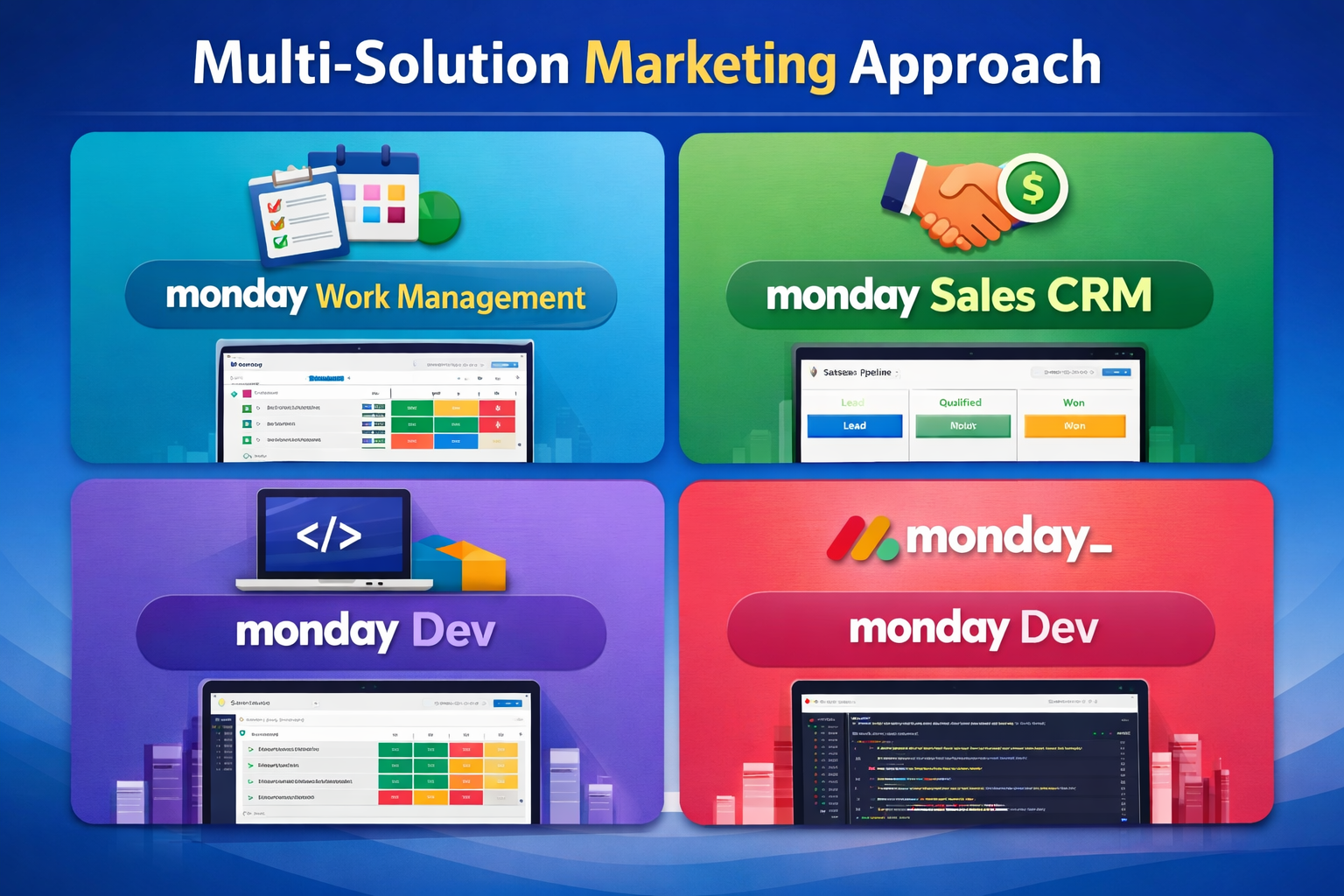
Multi-Solution Marketing Approach
Rather than marketing one generic product, monday.com splits its offerings into clear solutions.
monday Work Management
Focused on cross-team collaboration and planning.
monday Sales CRM
Tailored messaging for sales leaders and pipelines.
monday Dev
Positioned specifically for product and engineering teams.
This segmentation helps marketing speak directly to user pain points.
Targeting Multiple Buyer Personas
monday.com scales by selling to everyone, but not with the same message.
The core message stays the same, but the delivery adapts.
Conclusion
monday.com’s marketing strategy works because it respects the user’s time, intelligence, and workflow. Instead of shouting louder than competitors, it speaks clearer.
By combining product-led growth, strong branding, smart content, and data-driven decisions, monday.com proves that work management tools don’t just scale through features—they scale through empathy.
If your SaaS product helps people work better, monday.com is a blueprint worth studying.
Frequently Asked Questions
Q. What makes monday.com’s marketing strategy unique?
Its product-led growth approach combined with simple, human messaging.
Q. Is monday.com focused more on SMBs or enterprises?
Both. It uses segmented marketing to target each effectively.
Q. How important is content marketing for monday.com?